
maria sibylla merian centre
conviviality-inequality in latin america
maria sibylla merian centre
conviviality-inequality in latin america
Antonella Delmonte Allasia (CONICET / Mecila)
An interdisciplinary journey into health care, inequality, and urban life: this post reflects on Living and Dying in São Paulo (Duke University Press, 2025) and its rich ethnographic and methodological contributions to the social sciences.
In anthropology, methodology is never taken for granted; rather, we tend to reflect deeply on the very act of research, on the ethnographic endeavor itself. Following that tradition, when reading the book written by historian Jeffrey Lesser (Emory University / Mecila), I can only begin with methodology, since it was the very first aspect that caught my attention.
The book draws on various disciplines—history, anthropology, sociology, and geography—and therefore mobilizes a broad repertoire of sources and research methodologies, amounting to an almost showcase-like use of social science tools. The research was based on the analysis of historical and contemporary sources ranging from archives (such as the Public Health Archive), observations, cartography, digital maps, photographs, and participation in health programs. Jeffrey took part in health surveillance teams and in the primary care team at the Bom Retiro Public Health Clinic, in São Paulo. As the book itself notes, three different teams participated in the research in parallel, which made this kind of endeavor possible. These teams are both multidisciplinary and multinational.
I want to underline the reflections made on the researcher’s presence in the field. From the very beginning of the book, this presence is acknowledged and examined, as well as how it impacts the social configuration under analysis. And this is not only at the beginning; it resurfaces later on. For instance, when the text problematizes issues such as the clothes the researcher wears, how one enters the field, whether one introduces oneself, etc. It shows that the researcher is neither objective nor external, and that their presence also influences the construction of both data and arguments in the investigation.
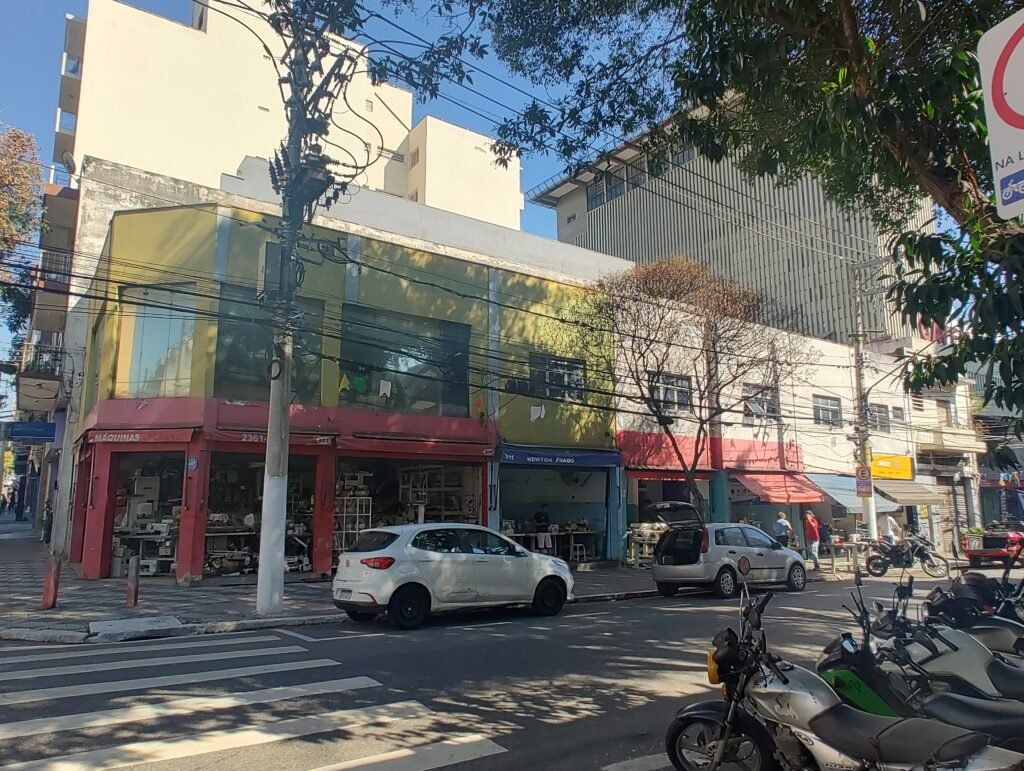
Image: Antonella Delmonte Allasia. A corner in Bom Retiro that sells and repairs machines.
Beyond methodology, I would like to highlight the temporal scope that the book handles. The period of analysis is broad, ranging from the mid-19th century to the present, always focused on the Bom Retiro neighborhood, as the research site. Despite being so broad, the study works because there is a thematic thread that ties everything together: the relationship between health, migration, and the urban environment. Thus, there is a central question that holds the book together, revolving around the practices of health and illness carried out by the state and its agents, and how people engage in everyday health practices. In this way, the book distances itself from a purely top-down perspective on public policies, bringing us closer to how these policies are actually carried out and how the residents of Bom Retiro receive them and act upon them.
Another important aspect is the spatial approach, since the book also analyzes how people and the state construct the space of Bom Retiro, and, at the same time, how that space shapes people and their health. Bom Retiro was and continues to be a central neighborhood in the urban social configuration, particularly for migrants, as well as for the construction of the health and illness of the population of São Paulo.
The book employs the analytical notion of “residues” (material, political, and social), which allows it to address historical continuities. The idea of residues refers simultaneously to structures of repetition and to residual subjects. For the history of social sciences (particularly anthropology), the category of residues is not an empty signifier; it carries connotations, a certain haunting meaning provocative at the same time. But here they acquire situated meanings, linked both to social practices and to the research problem.
Chapter 5, in particular, puts into practice what the introduction announces, in the sense that it traces in the present the residues of past ideas which, despite biomedical advances, continue to prevent improvements in health outcomes in Bom Retiro. To reach this conclusion, the book traces—from the 19th-century General Disinfectory to current Zika prevention campaigns—the tensions between the state, health officials, and the residents of Bom Retiro. And there it shows how the “residues” of public health workers’ attitudes toward migrants persist today, insofar as the migrant population continues to be perceived as the source and cause of various diseases. In contrast, the research highlights the influence of the urban environment, broadly conceived, as key to understanding the spread of disease.
Image: Cover of Jeffrey Lesser’s book “Living and dying in São Paulo”.
Last year, I participated in a roda de conversa (discussion circle) for women, which is held monthly in a pastoral center that provides support to migrants. The participants were exclusively migrant women from the Bom Retiro neighborhood. In one of the meetings, there were around 14 women, all Bolivian. Several had brought their children, who played in an adjacent room. All of them were seamstresses, except for one woman who was a psychologist. The meeting had three parts: first, conversation; second, games; and finally, a shared snack.
There, a game was played among women. It was “Musical Chairs”, where the goal was to find a seat. Since there was always one chair less than participants, someone always remained standing, and that person lost the round. The interesting part, in relation to the book, was one of the game’s rules. Whoever was left standing had to say her name, where she came from, what disease she carried, and whom she was going to infect. For example, I said: “I am Antonella, I come from Peru, I bring dengue, and I am going to infect everyone wearing black pants.” Then, all the women with black pants had to stand up and change seats, and so on. The game had the intended effect: we laughed and played for quite a while.
That day I noted the symbolic aspects of the game in my field notes but after reading the book, the game made even more sense and opened up new questions. Why do they choose those categories? Could it be that the game shows how actors are aware of being read through those categories associated with disease? If so, how do they put them into play creatively? In short, what do actors do with the categories of health and illness that subordinate them or that attempt to impose relations of subalternity? How do they put them into play creatively? Might they be showing the residues of ideas about health in other spaces not immediately connected with it?
Image at the top by Antonella Delmonte Allasia. An intercultural map inside Tiradentes station, in Bom Retiro.
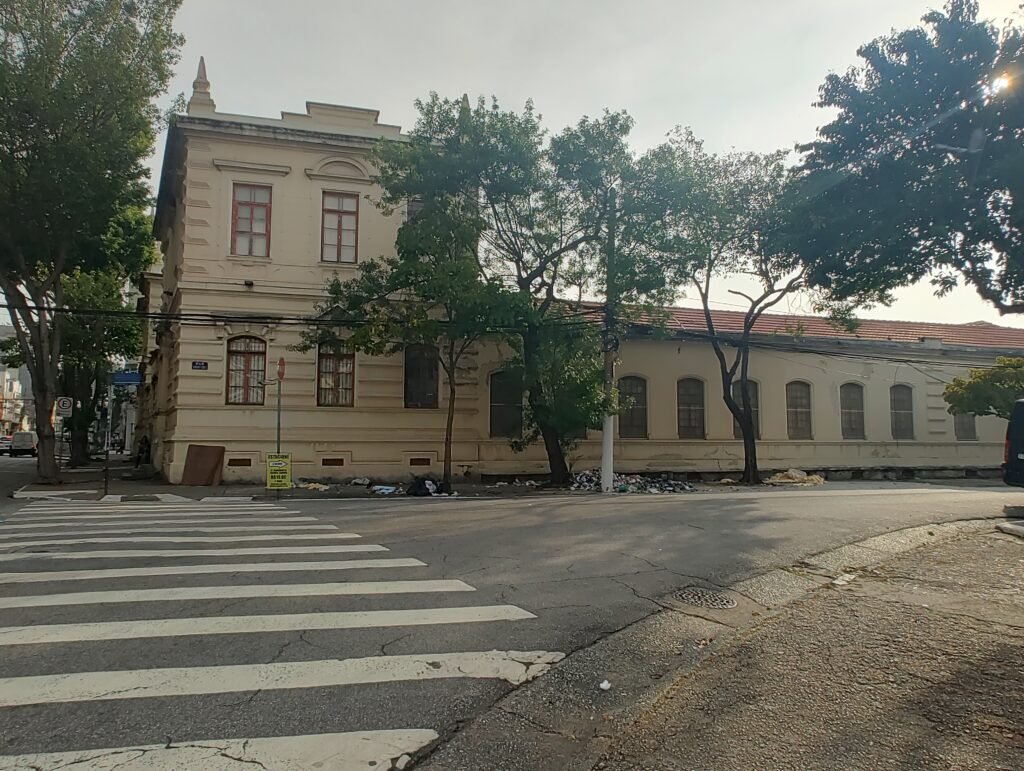
Image: Antonella Delmonte Allasia. Street next to the Emílio Ribas Public Health Museum in Bom Retiro, covered in rubbish.
Explore More on This Topic
📖 Viver e morrer em São Paulo: Imigração, saúde e infraestrutura urbana (século XIX até o presente), by Jeffrey Lesser (Brazilian edition, Editora da Unesp, 2025)
🎧 Dois Pontos (ep. 7): “Saúde, migração e o SUS: desafios e caminhos” (interview with Eugenia Brage, PAGU-Unicamp / Mecila)
🎧 Diálogos Mecila (ep. 20): “’El Alto no Brasil’. Migración y convivialidad en São Paulo” (interview with Gabriel Mamani Magni with Antonella Delmonte Allasia)
📖 Antonella Delmonte Allasia, “Costurar formas de vida y convivialidad. Reflexiones sobre el trabajo de mujeres migrantes en São Paulo más allá de la informalidad” (Mecila Working Paper Series, No. 88)
📖 Eugenia Brage, “Tramas populares-comunitarias de convivialidad. Reflexiones en torno a la sostenibilidad de la vida y la producción de lo común en contextos transfronterizos” (Mecila Working Paper Series, No. 72)