
maria sibylla merian centre
conviviality-inequality in latin america
maria sibylla merian centre
conviviality-inequality in latin america
In presence
Friday, March 27th 2026
10:00-15:00 hrs
Place: Department for Anthropology of the Americas
Room 1001, Oxfordstr. 15, 53111 Bonn
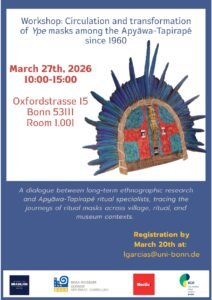
This workshop brings together academic research and Indigenous knowledge to examine the circulation, transformation, and contemporary meanings of Ype (Cara-Grande) masks among the Apyãwa-Tapirapé people since the late 1960s. It is grounded in long-term ethnographic research developed at Mecila by Ana Coutinho and focuses on the trajectories of ritual masks as they move between village, ritual, and museum contexts, acquiring new agencies, meanings, and materialities.
In the context of the exhibition Amazonia: Indigenous Creations and Futures at the Bundeskunsthalle, Dr. Ana Coutinho and two Apyãwa-Tapirapé ritual specialists will visit Bonn and the BASA Museum will host this workshop as a space for dialogue on Indigenous perspectives regarding the historical circulation of Ype masks, their transformations over time,
and their significance within and beyond Apyãwa communities.
The workshop is conceived as a roundtable conversation between two Indigenous ritual specialists, Paroo’i Tapirapé y Makato Koxamare’i Tapirapé, and the researcher Ana Coutinho. The discussion centers on the Indigenous strategy adopted by the Apyãwa-Tapirapé to produce masks specifically intended for circulation beyond the villages—objects conceived to enter museum collections while maintaining ritual continuity. In this process, the Ype mask occupies an intermediate position between ritual artifact and art object.
By foregrounding Indigenous perspectives on art, materiality, and museum relations, the workshop opens a space to reflect on negotiation, creativity, and agency in Indigenous engagements with ethnographic museums. It also aims to foster dialogue with museum professionals and to initiate future collaborations, including potential partnerships between the Indigenous museum in the Apyãwa village and European museum institutions.
Programme
10:15 Welcome and General Introduction by Carla Jaimes Betancourt
10:30 – 11:00 AMAZÔNIA. Indigenous creations and futures. The role of Ype masks in their journey by Leandro Varison- Deputy Director of the Department of Research and Education at the musée du quai Branly – Jacques Chirac.
11:00-12:30 Ana Coutinho – Remembering Enmity
Abstract
In ritual contexts, masks constitute an artifactual reference to enemy classes of the Kayapó, Karajá, and Ava-Canoeiro peoples—groups who carried out war raids against the Apyãwa over the last two centuries. The ritual enactment of masked enemies establishes a new temporality in relation to past warfare through the annual repetition of practices dealing with war spoils, represented as masked spirits (axyga).
In the past, the appearance of a mask spirit referred to a specific dead enemy—“that Kayapó who was killed in a particular place, in a particular way.” Over time, this individualized reference disappeared and was replaced by a generalized category of enemies. Rather than focusing on vengeance, Apyãwa ritual practice emphasizes the care of the enemy captive, articulating care and enmity in ways characteristic of classical Tupian rituals.
12:30 – 13:30 Lunch break
13:30 – 15:00 Paroo’i Tapirapé y Makato Koxamare’i Tapirapé – The “Cara-Grande / Ype Factory”: Agreements and Transformations since the late 1960s
Abstract
The social anthropologist Charles Wagley described witnessing, in 1966, what he called a veritable “factory” of mask production for sale among the Apyãwa. Masks were produced collectively inside the Takãra (ceremonial house), while everyday conversations took place, and later also in domestic spaces.
Following the sale of a mask identical to a ritually active one, internal discussions and political negotiations emerged. The sale of a mask actively involved in ritual life was deemed inappropriate, leading to a series of meetings to establish rules governing external sales and ritual continuity.
An agreement was reached among artisans, elders, men, and women to manage these two parallel processes. This pact—far from conflict- free—integrated relations with non-human enemy spirits and non-Indigenous buyers into a complex decision-making process. The ritual specialists will present the main material and formal alterations introduced so that the masks could circulate into museum spaces.
Please, register at lgarcias@uni-bonn.de by March 20th.