
maria sibylla merian centre
conviviality-inequality in latin america
maria sibylla merian centre
conviviality-inequality in latin america
In presence
Roundtable with Guests from the Brazilian Amazon
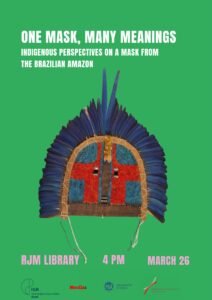
The starting point of the conversations will be the mask from the Rautenstrauch-Joest-Museum collection. This type of mask is known as “cara grande,” or “great face” in Portuguese. The mask was created by an artist of the Tapirapé community out of wood, fiber, and feathers. The Tapirapé live on the river of the same name (Rio Tapirapé) in the Brazilian state of Mato Grosso near the Araguaia. They call themselves Apyãwa (“true people”), while the commonly used Tupi word “Tapirapé” is synonymous with the Milky Way, which is literally called the “path of the tapir.”
The roundtable brings together Indigenous knowledge and academic research to discuss the circulation, transformation, and contemporary ritual and economic meanings of the masks since the late 1960s. With the Indigenous ritual specialists Paroo’i Tapirapé (Urubu Branco Indigenous Land, Mato Grosso state, Brazil), and Makato Koxamare’i Tapirapé (Urubu Branco Indigenous Land, Mato Grosso state, Brazil), and Dr. Ana Coutinho (MECILA Cologne/ Larme – National Museum of Rio de Janeiro, Brazil).