Exploring the Conviviality–Inequality Nexus: Findings and Prospects
Philipp Naucke & Sérgio Costa
From 11 to 13 December 2025, the Maria Sibylla Merian Centre Conviviality–Inequality in Latin America Mecila, hosted its Berlin Conference ‘Exploring the Conviviality–Inequality Nexus: Findings and Prospects’ at Freie Universität Berlin.
Bringing together scholars, artists, policy practitioners, and representatives of international research centres, particularly the Merian Centres based in Accra, Delhi, Guadalajara, and Tunis as well as the DFG Humanities Centre of Advanced Studies Futures of Sustainability and the GIGA Institute for Latin American Studies, the conference marked an important moment to take stock of Mecila’s work and to reflect collectively on future directions for research and collaboration. When Mecila began its activities, the challenges of living together in societies marked by deep and persistent inequalities were already evident. Today, these challenges have intensified. The conference was structured around three interrelated lines of conflict that shape contemporary debates on conviviality and inequality: the climate emergency and its uneven consequences; growing tensions in domestic and international politics; and widening North–South asymmetries in knowledge production and circulation. Over the three days, participants explored how these dynamics intersect and how they might be addressed through interdisciplinary and transdisciplinary research.
The conference kicked off with the welcome addresses by Günter M. Ziegler (President of Freie Universität Berlin), Silke Launert (State Secretary of the Federal Ministry of Research, Technology and Space), his excellence Rodrigo de Lima Baena Soares (Ambassador of Brazil in Germany), and Sérgio Costa (Mecila’s Spokesperson), setting the tone by locating the conference at the intersection of academic collaboration and global inequalities. The first roundtable, “Overcoming North–South Academic Asymmetries: Diagnosis and Responses”, gathered spokespersons and (former) directors of the Merian Centres in Accra (Hans-Peter Hahn), Delhi (Martin Fuchs), Guadalajara (Olaf Kaltmeier), Tunis (Rachid Ouaissa), and São Paulo (Susanne Klengel). Moderated by Laila Abu-Er-Rub (MIASA), the discussion highlighted the importance of sustainable partnerships, academic freedom, and knowledge diplomacy in a context marked by geopolitical uncertainty, nationalism, and shrinking spaces for critical scholarship. Rather than treating asymmetries as merely structural constraints, the panel emphasized the need for innovative institutional formats that actively reshape how research agendas are defined and pursued.
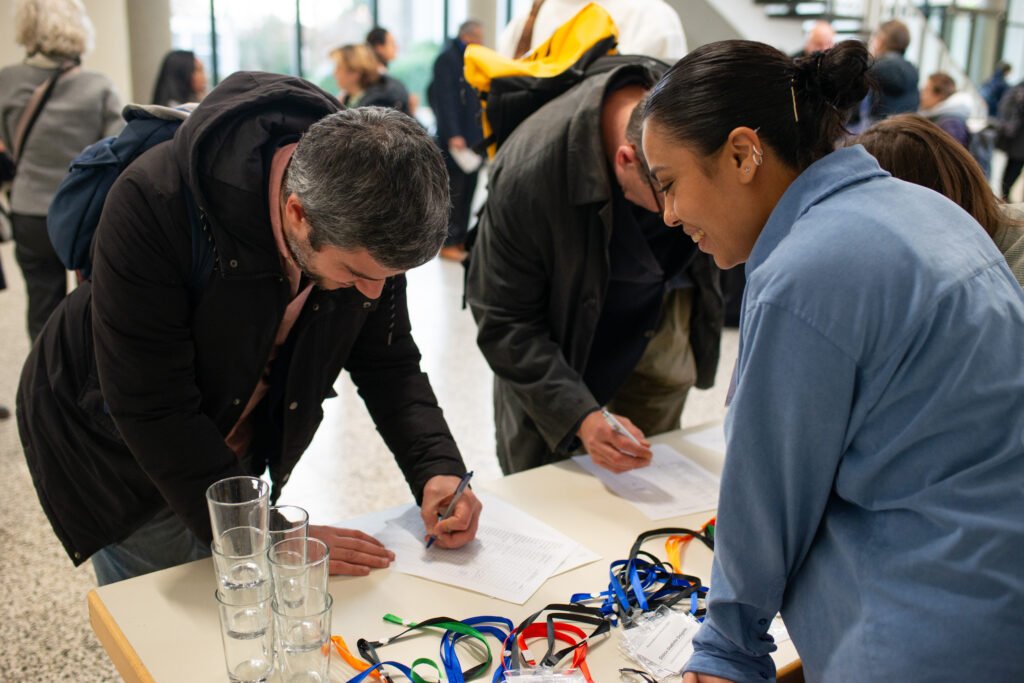
Photo by Gareth Harmer.
Questions of innovation and excellence in higher education were taken up again on the second day in a roundtable with university leaders and directors of Centres for Advanced Studies, such as Friederike Pannewick (German Science and Humanities Council), Robert Folger (Käte Hamburger Centre for Apocalyptic and Post-Apocalyptic Studies), Karin Harrasser (International Research Center for Cultural Studies), Verena Blechinger-Talcott (Freie Universität Berlin), and yet again Günter M. Ziegler and Sérgio Costa. Here, the focus shifted to the institutional frameworks required to support interdisciplinary research capable of responding to complex current societal and political challenges. Participants reflected on the tensions between academic autonomy, political pressures, and the growing demand for socially relevant research, underlining the role of universities and research centres as spaces for critical reflection in difficult times.
This institutional lens fed into the panel “Knowledges in Dialogue: From Interdisciplinary to Transdisciplinary”, which explored how academic, artistic, and experiential knowledge can transform each other when confronted with planetary crises. In this panel, Gioconda Herrera (FLACSO Ecuador) reflected transdisciplinary approaches to mobility and climate crises in the Andean region, showing how social and political actors’ situated knowledges reshape research on droughts, floods, and landslides. Awadhendra Sharan (Centre for the Study of Developing Societies, Delhi) proposed a framework for theorizing “atmospheres” in Anthropocene times that connects climate change, pandemics, and toxic air with histories of colonialism and global inequality. Artist and researcher Sela Adjei (University of Media, Arts and Communication, Ghana) discussed “Fragments of Conviviality”, reflecting on African visual cultures, restitution, and the politics of repair as forms of knowledge production that challenge extractive regimes between Europe and Africa. Finally, Cyrine Kortas (University of Gabes, Tunis) read Tunisian Sufi poetry through a transdisciplinary lens, treating it as a site where collective memory, devotional practice, gendered social roles, and national narratives intersect. Moderated by Julius Dihstelhoff (MECAM), these contributions illustrated that convivial futures require knowledge grounded in lived situations and negotiated across disciplinary and social boundaries.
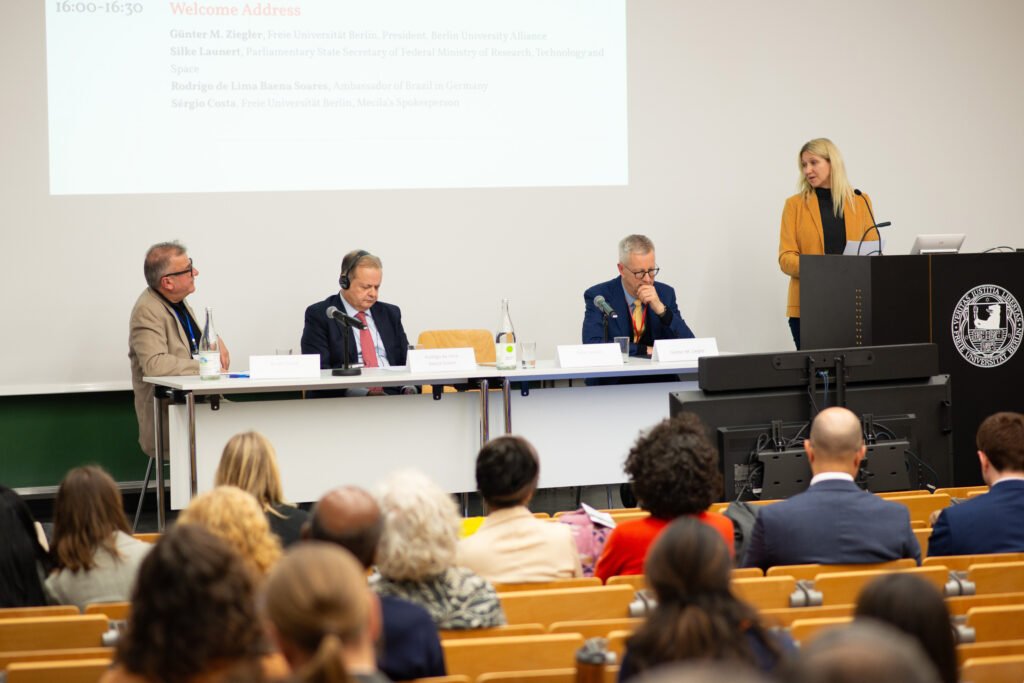
Photo by Gareth Harmer.
The afternoon panel “Climate Change and Multispecies Conviviality”, moderated by Manuel Santos Silva (Freie Universität, Mecila), extended this perspective to human–non‑human relations and socio‑ecological conflicts. Olivia Gomes da Cunha (Federal University of Rio de Janeiro) examined “fugitive relations” in Plantationocene worlds, focusing on Maroon communities in Suriname and their multispecies engagements with landscapes shaped by colonial extraction. Frank Adloff (University of Hamburg) argued for recognizing “nature’s gifts” and advancing a methodological animism that treats non‑humans as subjects, with implications for rights of nature and legal innovation. Maya Manzi (Federal University of Recôncavo da Bahia) connected pesticide‑driven water contamination in Western Bahia to the erosion of commons‑based livelihoods, showing how convivial relations between herders, cattle, and land are being undermined by agribusiness. Ulrich Brand (University of Vienna) analyzed the structural limits of the “decarbonisation state” within liberal capitalism and asked what a “transformation state” might mean for conviviality. The day concluded with a roundtable on “Disputing Environment and Climate Change”, moderated by Barbara Göbel (Ibero-American Institut Berlin), and bringing in perspectives from government, international cooperation, and academia – in person of Marta Machado (National Secretary for Drug Policies at the Ministry of Justice, Brazil); Sarah David (German International Cooperation – GIZ); and Guilherme Bianchi (University of São Paulo) – to explore how climate policies intersect with security, development, and justice.
The final day turned more explicitly to democracy and political agency. The morning panel “Democracy at the Crossroads: Challenges and Perspectives”, moderated by Marianne Braig (Freie Universität Berlin) addressed democratic crises in Latin America and beyond. Marcos Nobre (University of Campinas) introduced the concept of Bolsonarismo as a “digital party”, arguing that new, non‑institutionalized party forms emerging in digital spheres can disrupt existing regimes. Bert Hoffmann (GIGA Hamburg) highlighted how core elements of the res publica, from security to monetary infrastructures, are increasingly privatized, reframing what is at stake in democratic erosion. Ina Kerner (University of Koblenz) traced the “coloniality” of democracy, arguing that some of its crises are not recent aberrations but long‑standing features rooted in colonial histories. Luicy Pedroza (El Colegio de México) examined whether Latin America’s comparatively inclusive migration policies can withstand externalized border controls and domestic democratic backlashes. In the subsequent roundtable “Doing Politics in Difficult Times: The Contribution of Social Movements and Institutions”, the indigenous leader Yasmin Romero Epiayú (Wayuu, Colombia), the queer and abolitionist activist Ari Lutzker (YoNoFui Collective, Argentina), the political scientist Marisa Ramos Rollón (Universidad Complutense de Madrid), and the climate activist and poetess Fatim Selina Diaby (BUND) reflected on how collective action and institutional engagement shape politics under conditions of crisis. The discussion, moderated by Tomaz Amorim (University of Bochum), emphasized the need for alliances that connect local struggles with transnational networks, and that bridge social movements and formal institutions.
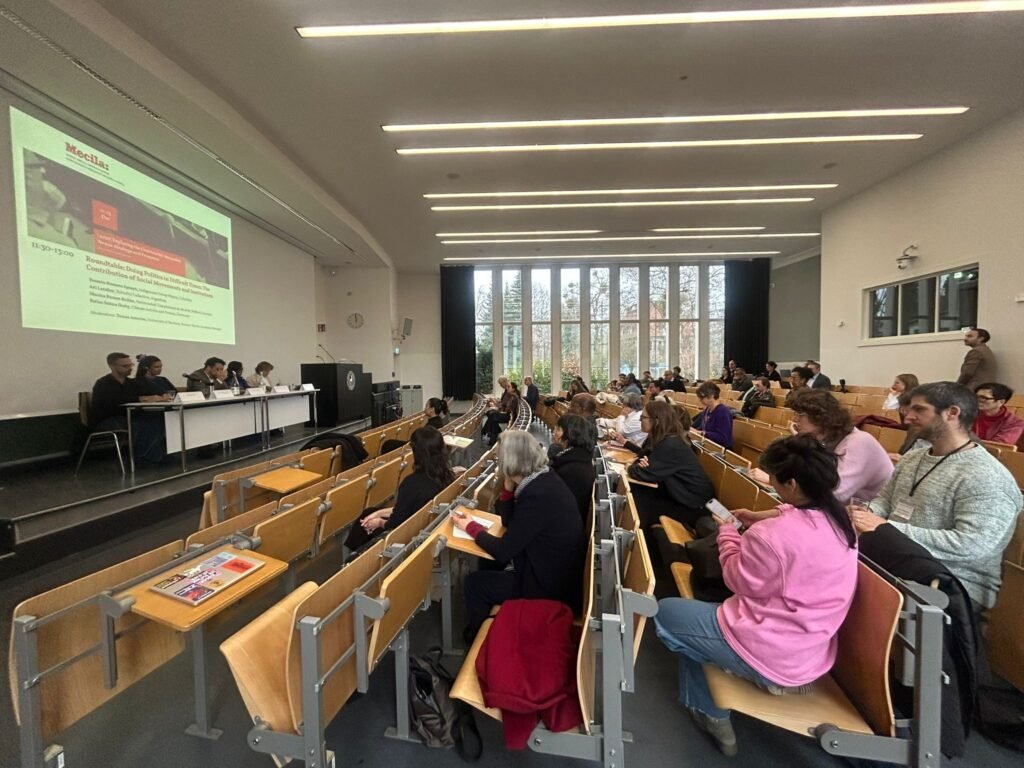
Photo by Mecila Berlin Office.
The conference concluded with a closing panel, moderated by Gesine Müller (University of Cologne, Mecila), that looked ahead to future collaborations among the Merian Centres and beyond. Reflecting on the discussions of the previous days, Encarnación Gutiérrez-Rodríguez (Goethe-Universität Frankfurt), Kristina Dietz (University of Kassel), Gloria Chicote (CONICET/University of La Plata, Argentina), Jörg Gengnagel (Julius-Maximilians-Universität Würzburg), and Mamadou Diawara (Goethe University Frankfurt) emphasized the need to further strengthen transregional and transdisciplinary networks, and to continue engaging with non-academic audiences. In doing so, Mecila’s work on conviviality and inequality was reaffirmed as both analytically rigorous and socially engaged. Overall, the Mecila Berlin Conference 2025 provided a space for critical reflection, dialogue, and prospecting. By bringing together diverse perspectives and forms of knowledge, it highlighted not only the depth of contemporary crises, but also the possibilities for reimagining conviviality under conditions of inequality. As the discussions made clear, addressing these challenges requires sustained collaboration across disciplines, regions, and institutional boundaries — a task that will continue to guide Mecila’s work in the years to come.