
maria sibylla merian centre
conviviality-inequality in latin america
maria sibylla merian centre
conviviality-inequality in latin america
Carlos M. Nupia (Visiting Research Fellow Justus Liebeg University Giessen)
The Maria Sibylla Merian Centres represent an unusually ambitious experiment in international academic cooperation in the humanities and social sciences. Established through long-term funding by the German Federal Ministry of Research, Technology and Space (BMFTR), the five Centres have connected German research institutions with academic communities in Latin America, Africa, Asia, and the Maghreb. Rather than supporting individual projects of relatively short duration, the initiative sought to create lasting institutional environments in which scholars from different countries, disciplines, and academic traditions could work together on major societal challenges.
As this long-term experiment matures, an increasingly important question arises: how can we assess the contribution to knowledge made by these international research centres?
The question is not simply how much they have produced. Publications, books, conferences, fellowships, workshops, podcasts, lectures, and other scientific and outreach products certainly provide important evidence of scientific activity. But international research centres are also expected to create something less easily captured by conventional indicators: connections between researchers, institutions, disciplines, and ideas. If international cooperation is one of their defining features, understanding their contribution requires us to examine not only their scientific outputs, but also the relationships through which knowledge has been produced and circulated.
This suggests a different way of thinking about the evaluation of international research centres: not only in terms of outputs and their impact, but also in terms of knowledge production and circulation.
Photo by Felipe Muci.
Scientific products as traces of knowledge
Knowledge circulation is difficult to observe directly. Conversations during a fellowship, exchanges at workshops, encounters between researchers, or the gradual movement of an idea from one disciplinary community to another may leave very different kinds of evidence. Yet international research centres produce a wide diversity of scientific and communicative products, and each of these — depending on its particular materiality — can leave traces that can potentially be followed.
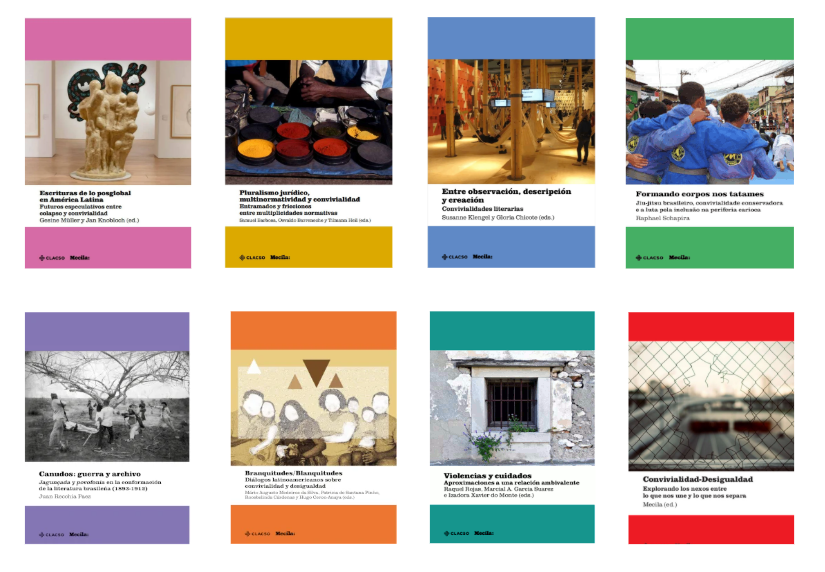
A book, a Working Paper, a podcast, a recorded lecture, a policy brief, or the programme of an academic event materialises knowledge in different ways. Each captures different aspects of the intellectual relationships generated within a research centre. Taken together, these materials may eventually allow us to reconstruct parts of the processes through which knowledge was produced, transformed, and circulated.
Among these different materialities, academic publications offer a particularly useful starting point. They are relatively standardised, cumulative, identifiable over time, and usually contain structured information about authorship, institutional affiliations, concepts, references, and research problems. They therefore make it possible to move systematically from individual scientific products toward the relationships connecting them.
Speaking specifically about the Maria Sibylla Merina Centre Conviviality-Inequality in Latin America (Mecila), it’s Working Paper Series provides an especially interesting case. It constitutes the Centre’s main editorial production and has accumulated almost one hundred papers written by scholars from different disciplinary, geographical, and institutional backgrounds. Normally, these papers are read individually: we look for a particular author, argument, concept, or empirical case. But what happens if we stop treating a Working Paper as an isolated document and begin to read the entire series as a network?
Photo by Felipe Muci.
From documents to relationships
This change of perspective opens a different set of questions.
Rather than simply counting papers or authors, we can ask how Mecila’s conceptual vocabulary has evolved over time. Which concepts repeatedly appear together? Which have travelled between disciplinary conversations? Have new conceptual clusters emerged? And which authors or institutions have helped connect otherwise separate areas of research?
This is particularly relevant to Mecila because the Centre was conceived around an interdisciplinary research problem: understanding the multiple interrelations between conviviality and inequality. Looking relationally at the Working Paper Series could therefore provide a more concrete way of examining how this conceptual programme has actually developed. Instead of asking only how individual authors have defined or applied conviviality, we could investigate how the concept has become connected to other concepts, problems, disciplines, and empirical fields throughout the Centre’s history.
In this sense, network analysis could help us ask a deceptively simple question: what has Mecila’s interdisciplinary research community collectively done with the concept of conviviality?
The papers also contain traces of the institutional structures through which this knowledge has circulated. Authors may simultaneously be affiliated with universities or research institutes and participate in Mecila as Junior or Senior Fellows, Doctoral Researchers, Principal Investigators, Postdoctoral Investigators, or in other roles. Institutional affiliation is therefore not merely an administrative detail. Considered longitudinally and relationally, it may help reveal some of the routes through which researchers — and potentially concepts and research questions — have moved across institutions and academic communities.
The Working Paper Series can thus be examined through several interconnected layers: concepts, authors, disciplines, institutions, and time. Connecting these layers may allow us to identify conceptual clusters, interdisciplinary encounters, institutional networks, and researchers who occupy bridging positions within the broader intellectual community.
The objective is not methodological sophistication for its own sake. It is to move from counting scientific products toward understanding relationships and trajectories of knowledge.
Mecila-CLACSO Book Series
From one materiality to a broader assessment of knowledge circulation
Publications, of course, capture only part of what happens within an international research centre. A Working Paper cannot record every conversation during a fellowship, every encounter at a colloquium, or every collaboration initiated during a research stay. For the same reason, the co-occurrence of two concepts in a publication cannot by itself demonstrate that knowledge has circulated between people or institutions.
But publications provide traceable material evidence of intellectual activity.
Reading those traces relationally and over time can offer a first reconstruction of patterns that remain difficult to see when scientific products are considered separately: concepts travelling across disciplines, researchers connecting intellectual communities, institutional relationships recurring through different projects, or contributions from Latin American institutions becoming central to particular conceptual debates.
The Working Papers could therefore be understood as a first analytical layer rather than the final object of evaluation. Once the relationships visible in this relatively standardised corpus have been reconstructed, the analysis could gradually be extended to other scientific materialities produced by the Centre — books, lectures, podcasts, events, policy-oriented publications, and other forms of knowledge production and communication. Different products would reveal different dimensions of circulation.
Such an approach could contribute to a broader discussion about how to assess the legacy of the Merian Centres. Long-term international research cooperation does not leave behind only a collection of outputs. It may also leave conceptual vocabularies, networks, institutional connections, interdisciplinary exchanges, and academic trajectories. Evaluating these less visible dimensions could help us understand not simply what an international research centre has produced, but what knowledge it has helped to create, how that knowledge has circulated, and which relationships may allow it to continue circulating beyond the institutional structures that initially supported it.
Looking at Mecila’s Working Papers as a knowledge network is only one possible starting point. But it raises questions that may be particularly relevant for the Centre’s own research community:
How has the concept of conviviality changed as it has moved across disciplines, research problems, and empirical contexts within Mecila?
Which researchers, institutions, and concepts have acted as bridges in the production and circulation of knowledge within the Centre — between Latin America and Europe, but also within Latin America itself?
And, more broadly, what would we learn about the contribution of international research centres if, alongside counting their outputs, we followed the relationships and trajectories of knowledge that those outputs leave behind?