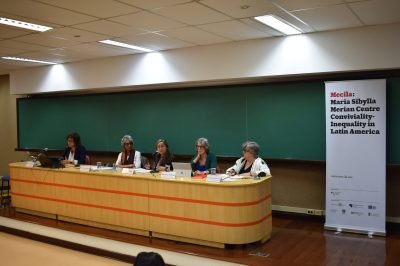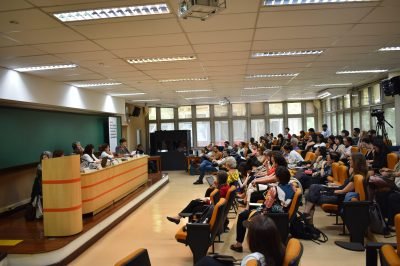
Mecila

#53

Exploring the Conviviality–Inequality Nexus: Findings and Prospects

Philipp Naucke & Sérgio Costa

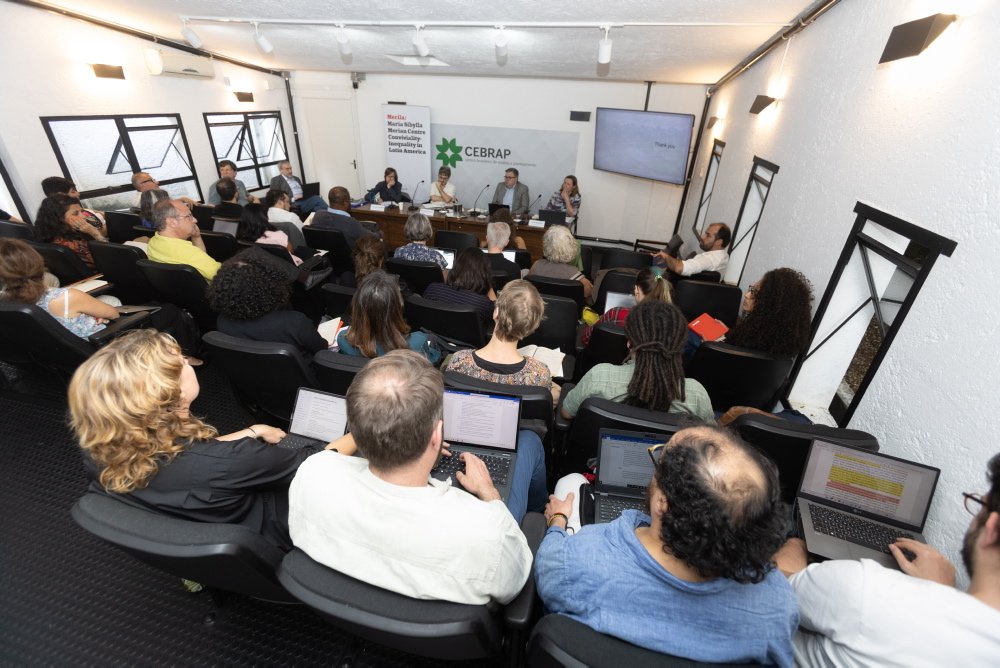
From 11 to 13 December 2025, the Maria Sibylla Merian Centre Conviviality–Inequality in Latin America Mecila, hosted its Berlin Conference ‘Exploring the Conviviality–Inequality Nexus: Findings and Prospects’ at Freie Universität Berlin.

Bringing together scholars, artists, policy practitioners, and representatives of international research centres, particularly the Merian Centres based in Accra, Delhi, Guadalajara, and Tunis as well as the DFG Humanities Centre of Advanced Studies Futures of Sustainability and the GIGA Institute for Latin American Studies, the conference marked an important moment to take stock of Mecila’s work and to reflect collectively on future directions for research and collaboration. When Mecila began its activities, the challenges of living together in societies marked by deep and persistent inequalities were already evident. Today, these challenges have intensified. The conference was structured around three interrelated lines of conflict that shape contemporary debates on conviviality and inequality: the climate emergency and its uneven consequences; growing tensions in domestic and international politics; and widening North–South asymmetries in knowledge production and circulation. Over the three days, participants explored how these dynamics intersect and how they might be addressed through interdisciplinary and transdisciplinary research.

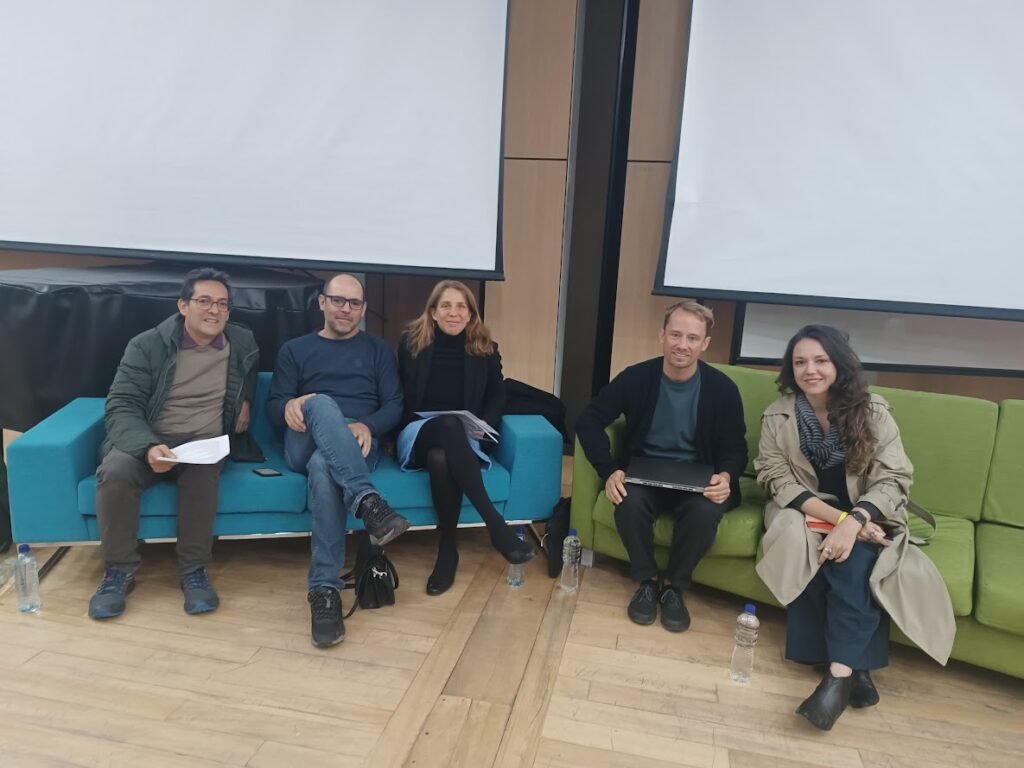
The conference kicked off with the welcome addresses by Günter M. Ziegler (President of Freie Universität Berlin), Silke Launert (State Secretary of the Federal Ministry of Research, Technology and Space), his excellence Rodrigo de Lima Baena Soares (Ambassador of Brazil in Germany), and Sérgio Costa (Mecila’s Spokesperson), setting the tone by locating the conference at the intersection of academic collaboration and global inequalities. The first roundtable, “Overcoming North–South Academic Asymmetries: Diagnosis and Responses”, gathered spokespersons and (former) directors of the Merian Centres in Accra (Hans-Peter Hahn), Delhi (Martin Fuchs), Guadalajara (Olaf Kaltmeier), Tunis (Rachid Ouaissa), and São Paulo (Susanne Klengel). Moderated by Laila Abu-Er-Rub (MIASA), the discussion highlighted the importance of sustainable partnerships, academic freedom, and knowledge diplomacy in a context marked by geopolitical uncertainty, nationalism, and shrinking spaces for critical scholarship. Rather than treating asymmetries as merely structural constraints, the panel emphasized the need for innovative institutional formats that actively reshape how research agendas are defined and pursued.
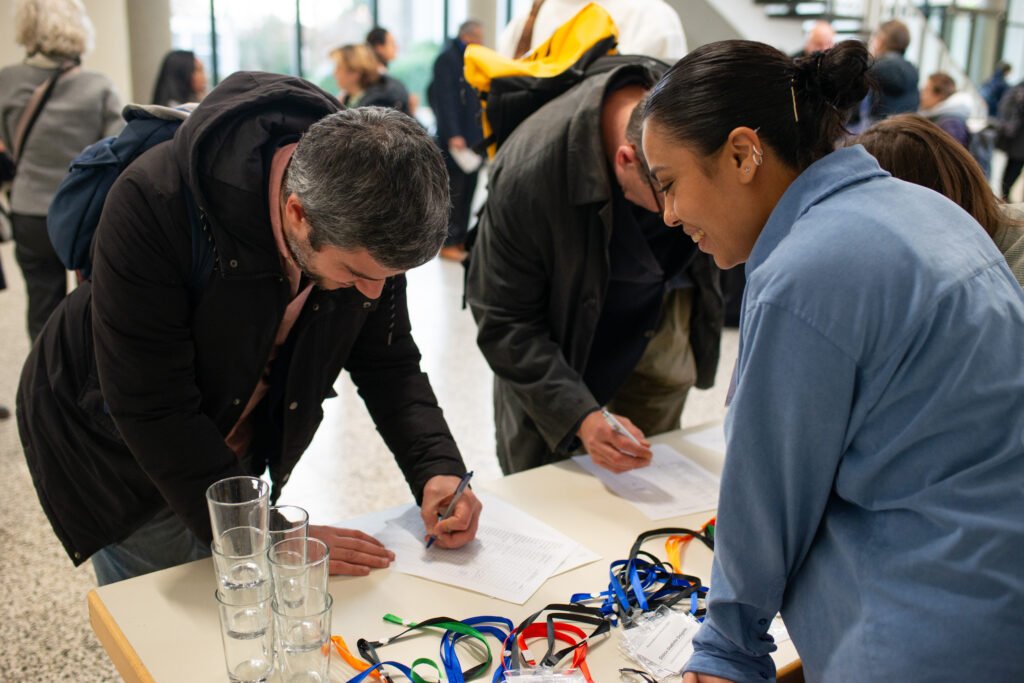
Photo by Gareth Harmer.

Questions of innovation and excellence in higher education were taken up again on the second day in a roundtable with university leaders and directors of Centres for Advanced Studies, such as Friederike Pannewick (German Science and Humanities Council), Robert Folger (Käte Hamburger Centre for Apocalyptic and Post-Apocalyptic Studies), Karin Harrasser (International Research Center for Cultural Studies), Verena Blechinger-Talcott (Freie Universität Berlin), and yet again Günter M. Ziegler and Sérgio Costa. Here, the focus shifted to the institutional frameworks required to support interdisciplinary research capable of responding to complex current societal and political challenges. Participants reflected on the tensions between academic autonomy, political pressures, and the growing demand for socially relevant research, underlining the role of universities and research centres as spaces for critical reflection in difficult times.

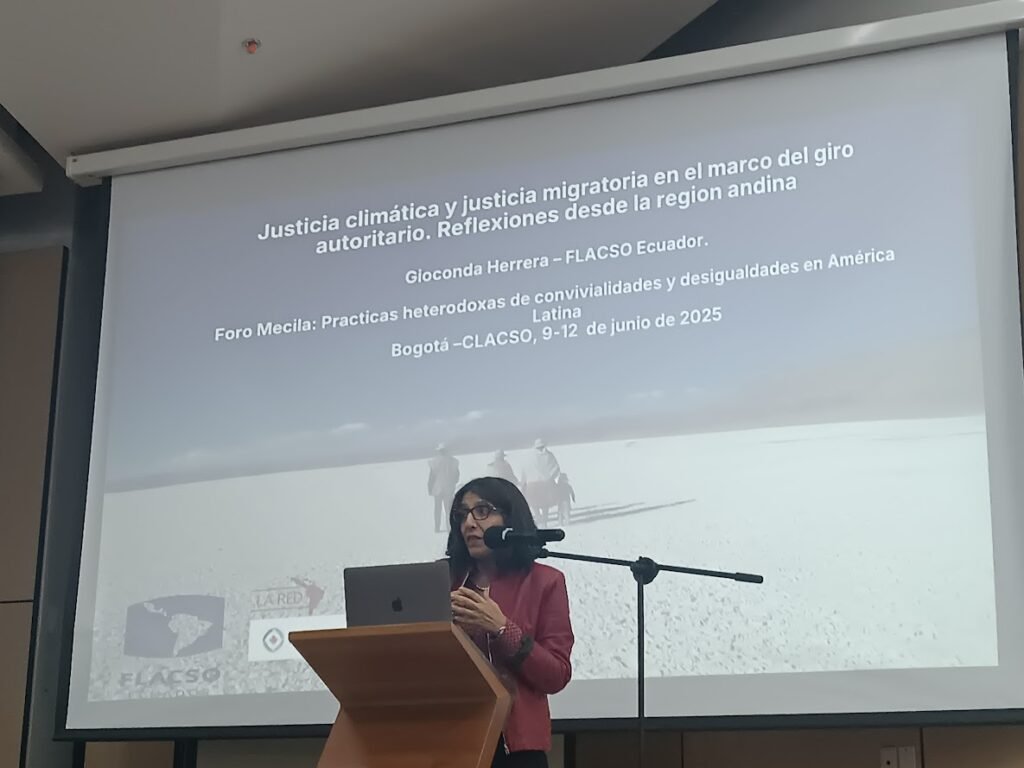
This institutional lens fed into the panel “Knowledges in Dialogue: From Interdisciplinary to Transdisciplinary”, which explored how academic, artistic, and experiential knowledge can transform each other when confronted with planetary crises. In this panel, Gioconda Herrera (FLACSO Ecuador) reflected transdisciplinary approaches to mobility and climate crises in the Andean region, showing how social and political actors’ situated knowledges reshape research on droughts, floods, and landslides. Awadhendra Sharan (Centre for the Study of Developing Societies, Delhi) proposed a framework for theorizing “atmospheres” in Anthropocene times that connects climate change, pandemics, and toxic air with histories of colonialism and global inequality. Artist and researcher Sela Adjei (University of Media, Arts and Communication, Ghana) discussed “Fragments of Conviviality”, reflecting on African visual cultures, restitution, and the politics of repair as forms of knowledge production that challenge extractive regimes between Europe and Africa. Finally, Cyrine Kortas (University of Gabes, Tunis) read Tunisian Sufi poetry through a transdisciplinary lens, treating it as a site where collective memory, devotional practice, gendered social roles, and national narratives intersect. Moderated by Julius Dihstelhoff (MECAM), these contributions illustrated that convivial futures require knowledge grounded in lived situations and negotiated across disciplinary and social boundaries.
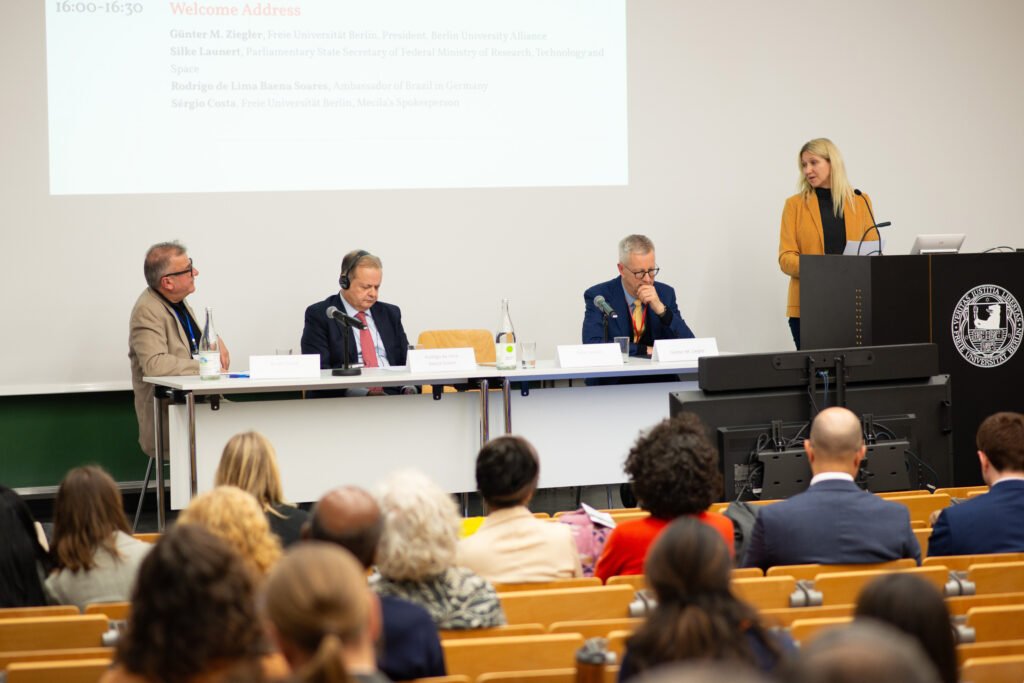
Photo by Gareth Harmer.

The afternoon panel “Climate Change and Multispecies Conviviality”, moderated by Manuel Santos Silva (Freie Universität, Mecila), extended this perspective to human–non‑human relations and socio‑ecological conflicts. Olivia Gomes da Cunha (Federal University of Rio de Janeiro) examined “fugitive relations” in Plantationocene worlds, focusing on Maroon communities in Suriname and their multispecies engagements with landscapes shaped by colonial extraction. Frank Adloff (University of Hamburg) argued for recognizing “nature’s gifts” and advancing a methodological animism that treats non‑humans as subjects, with implications for rights of nature and legal innovation. Maya Manzi (Federal University of Recôncavo da Bahia) connected pesticide‑driven water contamination in Western Bahia to the erosion of commons‑based livelihoods, showing how convivial relations between herders, cattle, and land are being undermined by agribusiness. Ulrich Brand (University of Vienna) analyzed the structural limits of the “decarbonisation state” within liberal capitalism and asked what a “transformation state” might mean for conviviality. The day concluded with a roundtable on “Disputing Environment and Climate Change”, moderated by Barbara Göbel (Ibero-American Institut Berlin), and bringing in perspectives from government, international cooperation, and academia – in person of Marta Machado (National Secretary for Drug Policies at the Ministry of Justice, Brazil); Sarah David (German International Cooperation – GIZ); and Guilherme Bianchi (University of São Paulo) – to explore how climate policies intersect with security, development, and justice.

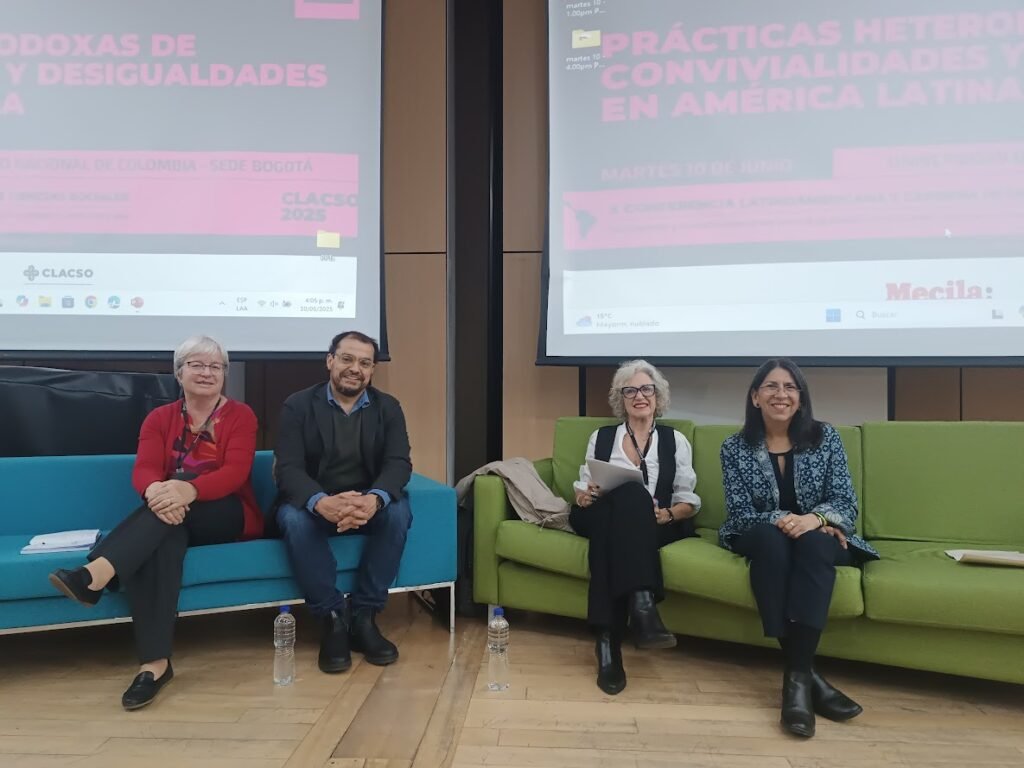
The final day turned more explicitly to democracy and political agency. The morning panel “Democracy at the Crossroads: Challenges and Perspectives”, moderated by Marianne Braig (Freie Universität Berlin) addressed democratic crises in Latin America and beyond. Marcos Nobre (University of Campinas) introduced the concept of Bolsonarismo as a “digital party”, arguing that new, non‑institutionalized party forms emerging in digital spheres can disrupt existing regimes. Bert Hoffmann (GIGA Hamburg) highlighted how core elements of the res publica, from security to monetary infrastructures, are increasingly privatized, reframing what is at stake in democratic erosion. Ina Kerner (University of Koblenz) traced the “coloniality” of democracy, arguing that some of its crises are not recent aberrations but long‑standing features rooted in colonial histories. Luicy Pedroza (El Colegio de México) examined whether Latin America’s comparatively inclusive migration policies can withstand externalized border controls and domestic democratic backlashes. In the subsequent roundtable “Doing Politics in Difficult Times: The Contribution of Social Movements and Institutions”, the indigenous leader Yasmin Romero Epiayú (Wayuu, Colombia), the queer and abolitionist activist Ari Lutzker (YoNoFui Collective, Argentina), the political scientist Marisa Ramos Rollón (Universidad Complutense de Madrid), and the climate activist and poetess Fatim Selina Diaby (BUND) reflected on how collective action and institutional engagement shape politics under conditions of crisis. The discussion, moderated by Tomaz Amorim (University of Bochum), emphasized the need for alliances that connect local struggles with transnational networks, and that bridge social movements and formal institutions.
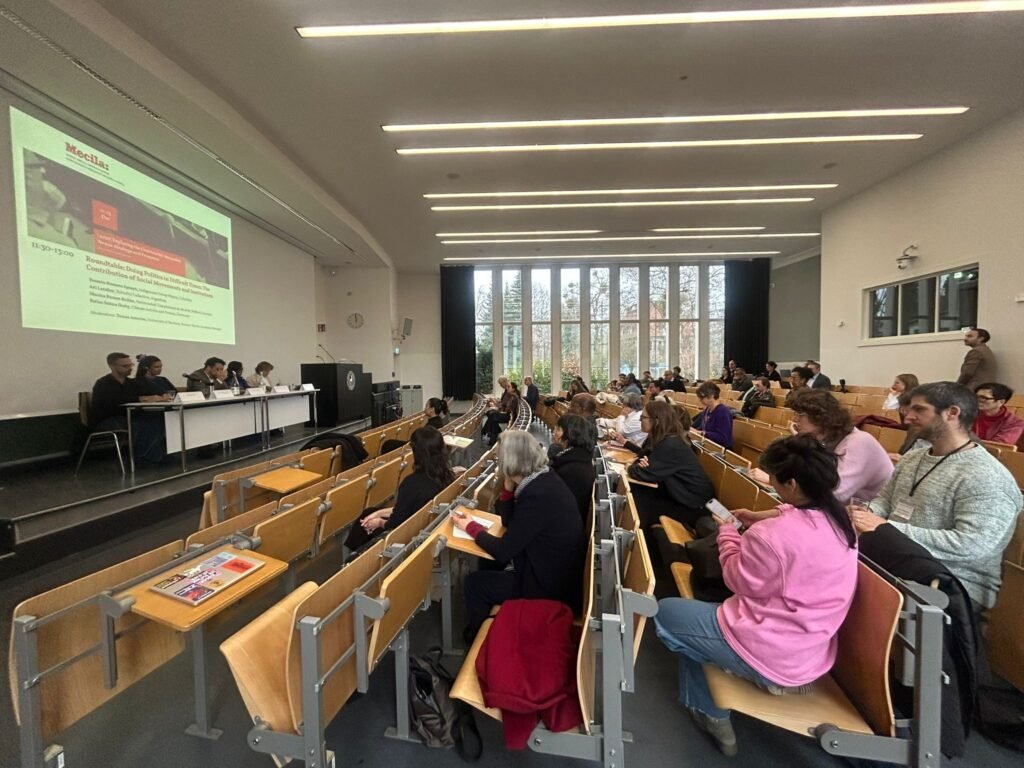
Photo by Mecila Berlin Office.

The conference concluded with a closing panel, moderated by Gesine Müller (University of Cologne, Mecila), that looked ahead to future collaborations among the Merian Centres and beyond. Reflecting on the discussions of the previous days, Encarnación Gutiérrez-Rodríguez (Goethe-Universität Frankfurt), Kristina Dietz (University of Kassel), Gloria Chicote (CONICET/University of La Plata, Argentina), Jörg Gengnagel (Julius-Maximilians-Universität Würzburg), and Mamadou Diawara (Goethe University Frankfurt) emphasized the need to further strengthen transregional and transdisciplinary networks, and to continue engaging with non-academic audiences. In doing so, Mecila’s work on conviviality and inequality was reaffirmed as both analytically rigorous and socially engaged. Overall, the Mecila Berlin Conference 2025 provided a space for critical reflection, dialogue, and prospecting. By bringing together diverse perspectives and forms of knowledge, it highlighted not only the depth of contemporary crises, but also the possibilities for reimagining conviviality under conditions of inequality. As the discussions made clear, addressing these challenges requires sustained collaboration across disciplines, regions, and institutional boundaries — a task that will continue to guide Mecila’s work in the years to come.
#52

Professor Guillermo Obiols Library: Supporting Research and Learning within Mecila (2020–2026)

The Ibero-Amerikanisches Institut Editorial Team 

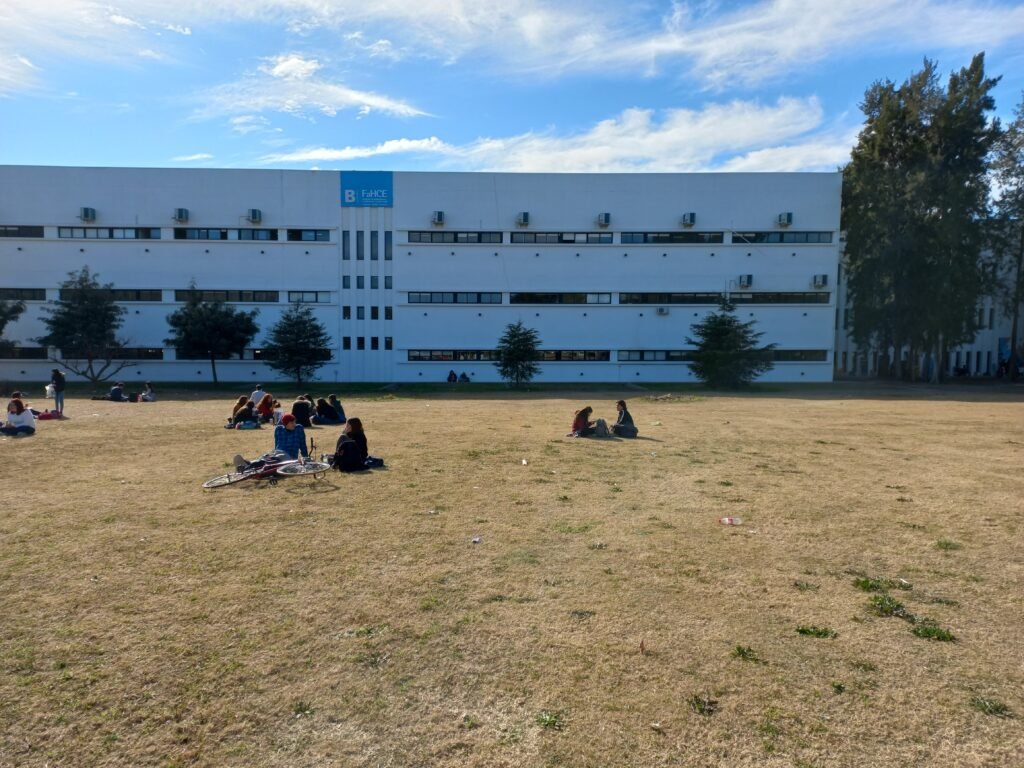
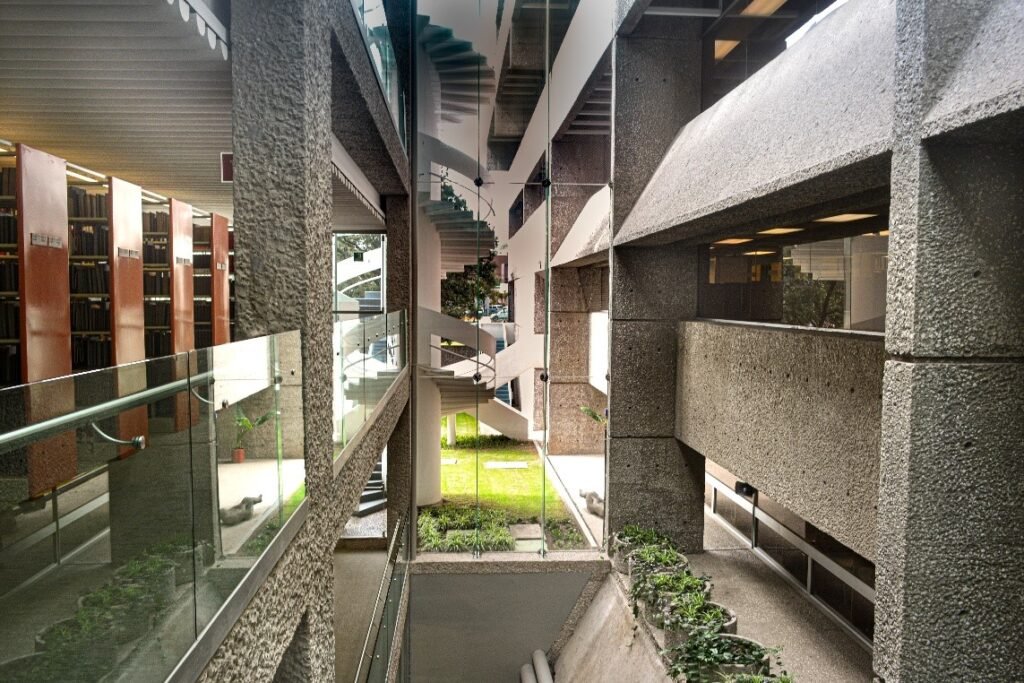
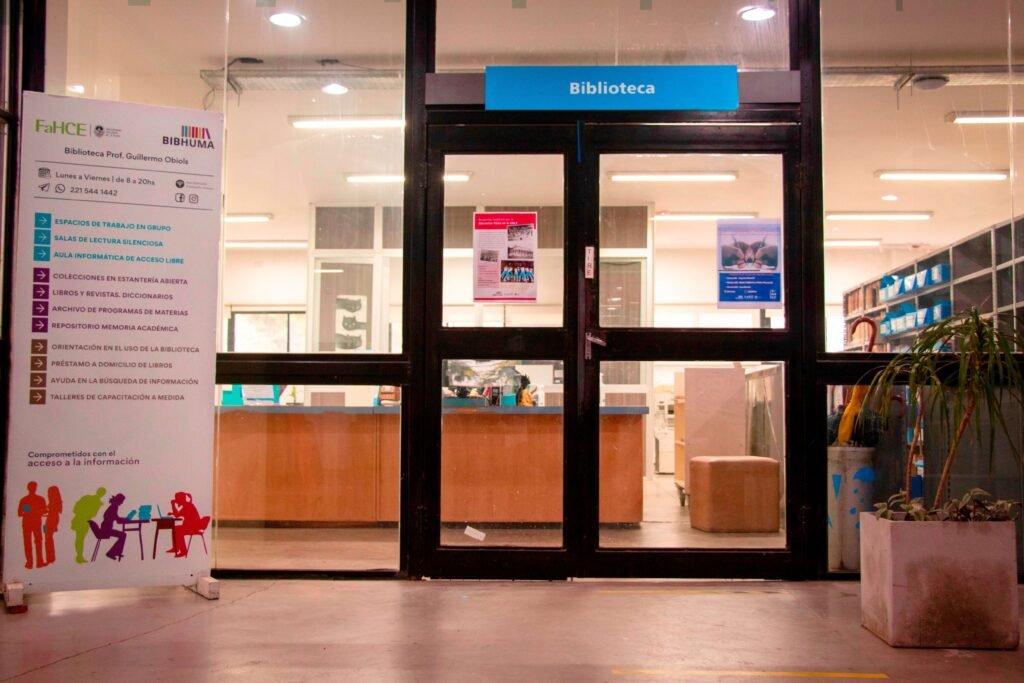
The Prof. Guillermo Obiols Library is a support service for teaching, study, research, outreach, and management at the Faculty of Humanities and Education Sciences and the Institute for Research in Humanities and Social Sciences at the National University of La Plata.

As part of Mecila’s information infrastructure, the Library develops active library services aimed at ensuring the generation, communication, and dissemination of information and knowledge to its user community in general, and to researchers, fellows, and thesis writers of the Mecila consortium in particular.

The “Prof. Guillermo Obiols” Library is a support service for teaching, study, research, outreach, and management at the Faculty of Humanities and Education Sciences (hereinafter FaHCE) and the Institute for Research in Humanities and Social Sciences (hereinafter IdIHCS) of the National University of La Plata (hereinafter UNLP).

Its mission is to propose and intervene on demand in the academic processes of FaHCE and IdIHCS, with bibliographic resources, professional capabilities, physical spaces, and library services designed to guarantee, facilitate, and contribute to the generation, communication, and dissemination of information and knowledge.

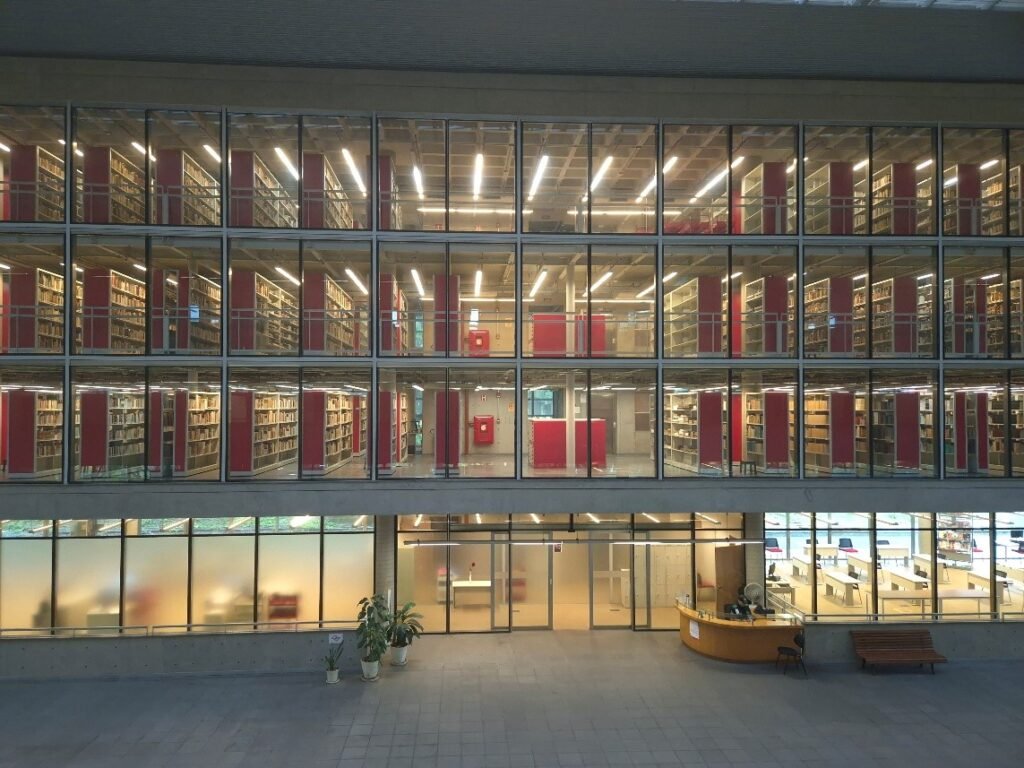
Prof. Guillermo Obiols Library

FaHCE focuses its teaching on training outstanding professionals who are committed to addressing educational, human, social, and territorial issues in the community. The IdIHCS, as its research body, carries out more than 200 projects in its 18 centers and laboratories, employing 240 researchers and 190 fellows. It is part of international networks such as Mecila and coordinates federal initiatives and other interinstitutional programs.

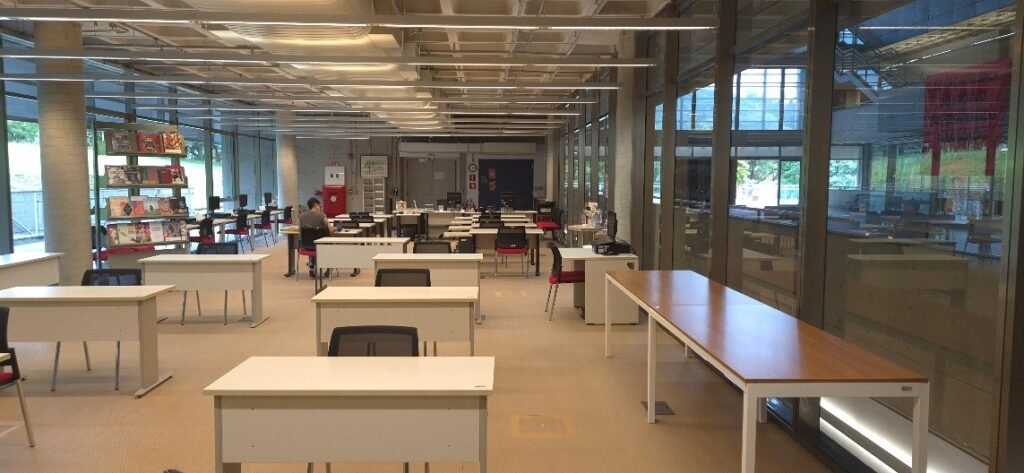
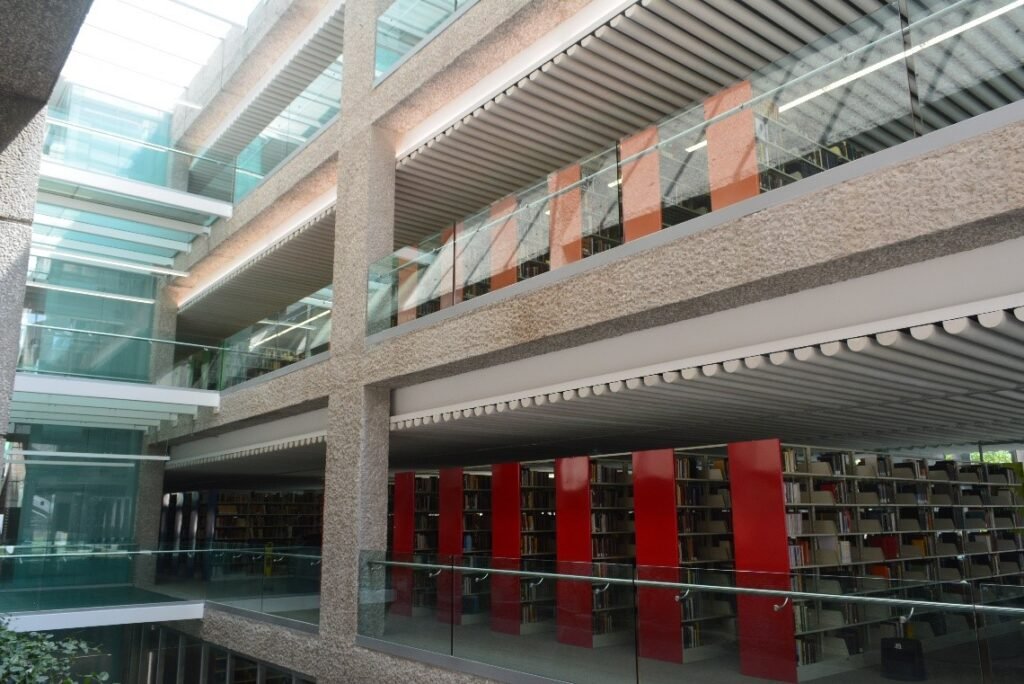
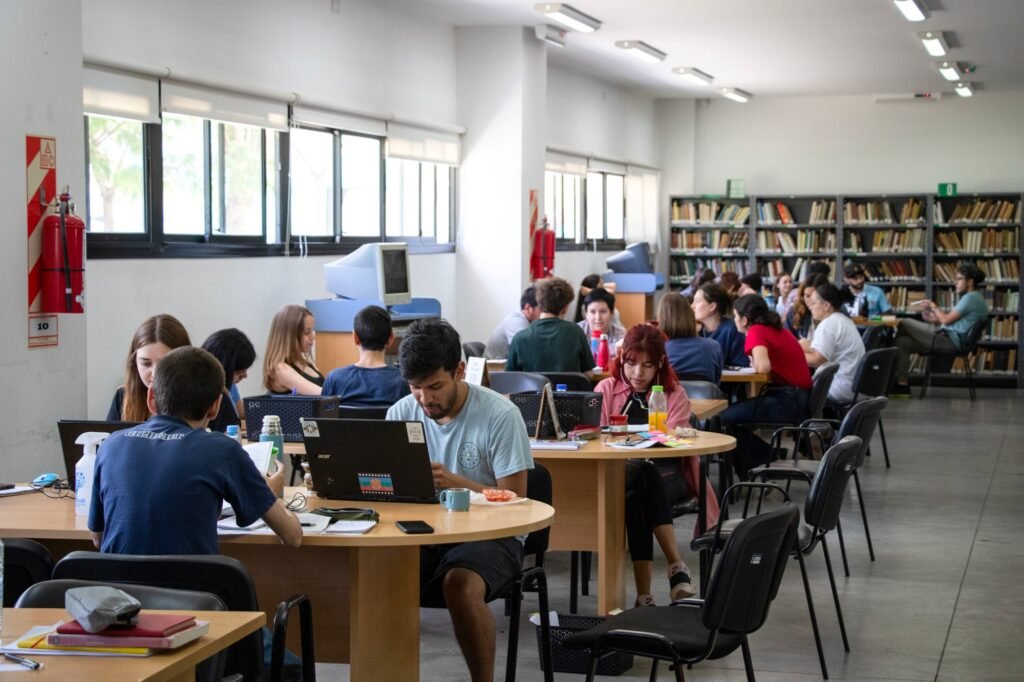
The Prof. Guillermo Obiols Library has a collection of more than 120,000 books and 3,700 printed journals, as well as more than 65,000 digital resources. It welcomes 200 people per day to its study areas and provides personalized service for researchers, advising on open access, bibliographic reference managers, obtaining external documents, training in searches and intellectual property, entry into research careers, among other topics. Likewise, in its vision of community engagement, it offers integrated spaces for book presentations, conferences, and exhibitions, where valuable documents from the collection are linked to specific themes proposed by research groups.

Prof. Guillermo Obiols Library

In addition, it manages the institutional repository Memoria Académica, with the obligation to deposit the scientific production of researchers, through an open access policy of the FaHCE/IdIHCS (Resolution 527/2021) and the UNLP (Ordinance 302/2021) in compliance with the provisions of National Law 26.899/2013 and Resolution 753/2016 that regulates it. To date, it has collected around 53,000 documents, including journal articles, books, presentations at events, theses, and research and extension projects. In collaboration with the IdIHCS, it advises its researchers and curates data for the deposit of primary research data in the institutional repository and in the UNLP data repository.

It also works with IdIHCS to develop ARCAS, a repository of sources of interest for research, with collections of manuscripts by authors such as Manuel Puig and Edgardo Vigo, among others, interviews and oral recordings made for the study of language with their transcripts, and other institutional archival materials.

Prof. Guillermo Obiols Library

#51

Library of the Institute of Brazilian Studies at the University of São Paulo, Brazil

The Ibero-Amerikanisches Institut Editorial Team

The Institute of Brazilian Studies at the University of São Paulo (IEB/USP) is an interdisciplinary research center dedicated to the preservation, dissemination, and study of a collection of recognized academic relevance, consisting of personal collections distributed among the Archive, Library, and Visual Arts Collection.

Its Library houses one of the most significant Brasiliana collections in the country, with approximately 270,000 volumes organized into 47 collections. Linked to the Institute’s other collections, the Library facilitates the production of qualified research and critical reflection on Brazil, while also promoting academic exchange with similar institutions, both nationally and internationally.

The Institute of Brazilian Studies at the University of São Paulo (IEB/USP) was created in 1962 on the initiative of historian Sérgio Buarque de Holanda. Since then, it has served as an integrating body for one of the largest and most prestigious universities in the country and as an interdisciplinary research center focused on critical reflection on Brazil. Since its inception, the Institute has been structured around the articulation between the Archive, Library, and Visual Arts Collection, bringing together under its care documentary collections that dialogue with multiple areas of knowledge, such as Anthropology, Architecture, Fine Arts, Library Science, Political Science, Cinema, Law, Economics, Education, Philosophy, Geography, History, Literature, Music, Sociology, Museology, and Theater.

The IEB is thus responsible for the preservation, dissemination, and research of an exceptional collection, consisting mainly of personal archives and collections assembled during their lifetimes by prominent Brazilian intellectuals, writers, and artists. These collections reflect comprehensive and dense analytical perspectives on the country’s social, cultural, and artistic thought, making them fundamental primary sources for academic research. In this sense, it is part of the IEB’s institutional mission to promote qualified access to this heritage, as well as to encourage its critical appropriation by professors, researchers, undergraduate and graduate students, both from USP and other national and international institutions, expanding the possibilities for teaching, research, and university extension.

Library of the Institute of Brazilian Studies at the University of São Paulo (IEB/USP)

The IEB Library plays a central role in this complex, constituting one of the main centers for research in Brazilian Studies in the country. With one of the most important collections of Brazilian literature in Brazil, the Library has around 270,000 volumes distributed across 47 collections, associated with key figures in Brazilian culture and thought, such as Mário de Andrade, Caio Prado Jr., Graciliano Ramos, Celso Furtado, Guimarães Rosa, José Aderaldo Castello, and Manuel Correia de Andrade, among others. Its collection also includes the oldest incunabulum in the custody of the University of São Paulo, dating from 1493, as well as rare collections of sermons from the 16th and 17th centuries, travel accounts from the 18th and 19th centuries, and a significant collection of periodicals from the late 19th and early 20th centuries.

Organically integrated with the Visual Arts Archive and Collection, the IEB Library not only preserves and organizes knowledge, but also acts as an active agent in intellectual production, enabling interdisciplinary research, fostering academic exchange, and contributing to the development of innovative research tools. The close relationship between the collection and scientific research thus constitutes a vector of institutional innovation, incorporating both established fields—such as Archival Science and Museology—and emerging approaches, such as Digital Humanities.

True to its mission, the IEB reaffirms values such as the protection of cultural heritage, the democratization of information and knowledge, freedom of thought and expression, diversity and social inclusion, and an ongoing commitment to dialogue with society. Supported by a monumental collection and consolidated interdisciplinary practices, the Institute stands out as a national and international reference in Brazilian Studies, contributing decisively to critical reflection on Brazil and to addressing the educational, economic, and social inequalities that mark the country’s reality.

#50

From Archive to Network: How the Daniel Cosío Villegas Library Supports Mecila’s Transnational Research

The Ibero-Amerikanisches Institut Editorial Team

The Daniel Cosío Villegas Library at El Colegio de México (COLMEX), open to the public, strengthens interdisciplinary research in the humanities and social sciences. Through the integration of its collections and resources into the digital infrastructure of the Mecila project, it facilitates academic exchange between Latin America and Europe.

El Colegio de México is a public, university-level institution dedicated to research and advanced teaching in the social sciences and humanities. It is one of the most distinguished institutions in the Spanish-speaking world and has received numerous accolades since its founding in 1940.

To fulfill its mission, El Colegio de México conducts research and offers graduate instruction through its specialized research centers: Historical Studies, Linguistic and Literary Studies, International Studies, Asian and African Studies, Economic Studies, Urban and Environmental Demographic Studies, Sociological Studies, and Gender Studies. The institution offers undergraduate, master’s, and doctoral degrees in specialized fields, as well as specialized and summer courses.

Biblioteca Daniel Cosío Villegas

The Daniel Cosío Villegas Library (BDCV) at El Colegio de México is recognized as a leading institution in Mexico and Latin America. Its standing is grounded in the richness of its collections, the high quality of its bibliographic processes, and a range of specialized services designed to support the academic community.

The library’s vision is to remain the intellectual heart of the institution and to serve as an internationally recognized model of an inclusive, innovative, and transdisciplinary academic library. Its mission is to support research, teaching, learning, reflection, and creativity. By connecting individuals with high-quality information, the BDCV empowers people, fosters critical thinking, and promotes the effective and sustainable use of information resources. It remains committed to open knowledge, the right to information, the preservation of institutional memory, and the advancement of information sciences. As a public space for encounter, development, and exchange of ideas, the library serves as a dynamic hub for intellectual engagement.

With a collection exceeding 625,000 books and over 770,000 printed volumes, and access to a wide range of electronic resources, the BDCV houses one of the most important Latin American collections in the social sciences and humanities. Its holdings span key fields such as public administration, economics, international studies, demography, urban development, history, linguistics, Hispanic literature, political science, sociology, gender studies, translation, and the social impact of science and technology.

Biblioteca Daniel Cosío Villegas

The library has undertaken numerous digital initiatives, resulting in the creation of its digital collections. Among these is the institutional repository, which provides open access to approximately 3,000 publications produced by El Colegio de México.

As a research library, the BDCV has been a strategic partner of the Mecila project since 2020. This collaboration is based on the cross-continental exchange of resources between Latin America and Germany, facilitated through integration into the digital infrastructure coordinated by the Ibero-Amerikanisches Institut (IAI) in Berlin.

The BDCV’s goal of strengthening bibliographic cooperation through international programs and agreements finds in Mecila an ideal ecosystem to expand its capacity to support research, teaching, and learning. In line with its commitment to providing services that are relevant, timely, efficient, flexible, and accessible, the library contributes to Mecila’s mission of ensuring that fellows and researchers across the network can access high-quality information regardless of their geographic location.

This synergy reinforces the Daniel Cosío Villegas Library’s international leadership while simultaneously expanding the Mecila Information Infrastructure into a vibrant space for transnational scientific collaboration. Together, these efforts advance shared objectives: broadening access to information resources, fostering knowledge production, and strengthening academic networks across continents.

#49

The Ibero-American Institute (IAI): Collections, Research, and Global Scholarly Exchange

The Ibero-Amerikanisches Institut Editorial Team 

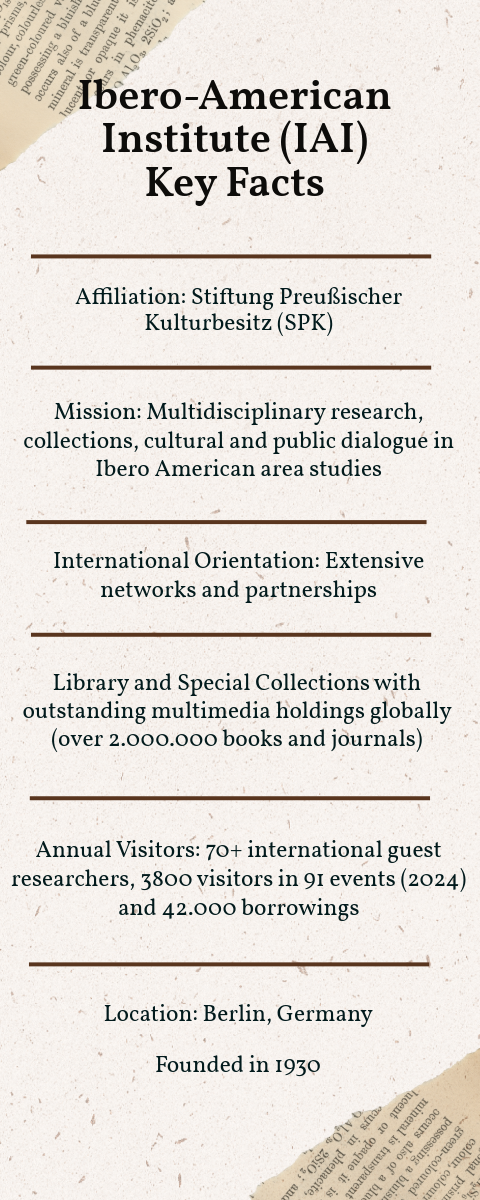
The Ibero-American Institute (IAI), Stiftung Preußischer Kulturbesitz (SPK), is a multidisciplinary research institute bringing together collections, research and events. With a focus on Latin America, the Caribbean, Spain and Portugal, the IAI fosters international academic exchange. In February 2026, it will host the Mecila Institutional Workshop.

The Ibero‑American Institute (IAI), Stiftung Preußischer Kulturbesitz (SPK), is a multidisciplinary non‑university research institute for the humanities, cultural studies and social sciences. As an area studies institution, it has a regional focus on Latin America, the Caribbean, Spain and Portugal, while also taking into account transregional interconnections. The institute’s unique profile is defined by its genuinely international orientation and the equal integration of different areas of work under one roof: collections, research and events.

At the heart of the IAI are its Library and Special Collections, which form Europe’s largest specialised research archive on Latin America, the Caribbean, Spain, and Portugal, encompassing well over two million items, including analog and digital books and journals, audiovisual media, maps, photographs, and other sources. These collections are distinguished by their cultural diversity, geographical breadth, and historical depth, and they serve as a shared global cultural heritage. The IAI continuously develops and expands these resources, making them accessible to scholars worldwide and supporting research that connects local, regional, and transregional perspectives.

The Library and Special Collections of the Ibero-American Institute (IAI) provide the basis for the institute’s research activities and international collaborations. Complemented by partnerships with universities and cultural institutions, the IAI hosts visiting researchers and produces a multilingual publication program. The combination of collections, research, and publications creates a space for the production and transfer of knowledge, as well as for the mediation of cultural perspectives across regions and disciplines.

Cultural and scientific events are central to the IAI’s mission, too. The institute’s event programme is interdisciplinary, multidisciplinary and multilingual, and is carried out with a wide range of partners. Conferences, lectures, exhibitions and other formats provide spaces for dialogue between scholars, cultural actors and the broader public and connect research with societal themes. These events contribute to public understanding of complex issues, from knowledge transfer and cultural heritage to contemporary global challenges, through an Ibero‑American lens.

Founded in 1930, the IAI has evolved into an established institution for dialogue between Germany and the Ibero‑American world. Since 1962, it has been part of the Stiftung Preußischer Kulturbesitz (SPK, Prussian Cultural Heritage Foundation), one of the largest cultural and scientific institutions worldwide. Within the SPK network, the IAI brings specific expertise and knowledge on Latin America, the Caribbean, Spain and Portugal.

In February 2026 (18–20), the IAI will host the Mecila Institutional Workshop, a central event of the Mecila Research Network and its information infrastructure. The workshop will bring together researchers, librarians, and technical coordinators from leading institutions in Latin America and Europe to discuss the current state and future development of collaborative knowledge infrastructures supporting interdisciplinary research.


Photos Copyright: SPK/photothek.net/Florian Gaertner

#48

Notes on Jeffrey Lesser’s “Living and Dying in São Paulo”

Antonella Delmonte Allasia (CONICET / Mecila)

An interdisciplinary journey into health care, inequality, and urban life: this post reflects on Living and Dying in São Paulo (Duke University Press, 2025) and its rich ethnographic and methodological contributions to the social sciences.

In anthropology, methodology is never taken for granted; rather, we tend to reflect deeply on the very act of research, on the ethnographic endeavor itself. Following that tradition, when reading the book written by historian Jeffrey Lesser (Emory University / Mecila), I can only begin with methodology, since it was the very first aspect that caught my attention.

The book draws on various disciplines—history, anthropology, sociology, and geography—and therefore mobilizes a broad repertoire of sources and research methodologies, amounting to an almost showcase-like use of social science tools. The research was based on the analysis of historical and contemporary sources ranging from archives (such as the Public Health Archive), observations, cartography, digital maps, photographs, and participation in health programs. Jeffrey took part in health surveillance teams and in the primary care team at the Bom Retiro Public Health Clinic, in São Paulo. As the book itself notes, three different teams participated in the research in parallel, which made this kind of endeavor possible. These teams are both multidisciplinary and multinational.

I want to underline the reflections made on the researcher’s presence in the field. From the very beginning of the book, this presence is acknowledged and examined, as well as how it impacts the social configuration under analysis. And this is not only at the beginning; it resurfaces later on. For instance, when the text problematizes issues such as the clothes the researcher wears, how one enters the field, whether one introduces oneself, etc. It shows that the researcher is neither objective nor external, and that their presence also influences the construction of both data and arguments in the investigation.

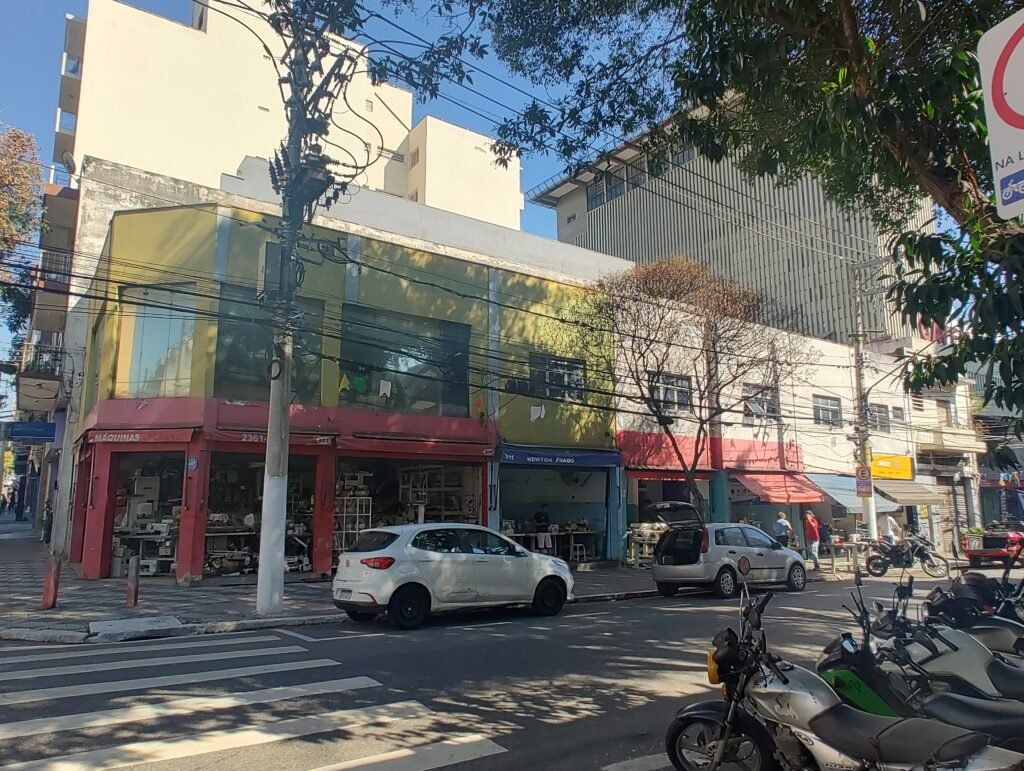
Image: Antonella Delmonte Allasia. A corner in Bom Retiro that sells and repairs machines.

Beyond methodology, I would like to highlight the temporal scope that the book handles. The period of analysis is broad, ranging from the mid-19th century to the present, always focused on the Bom Retiro neighborhood, as the research site. Despite being so broad, the study works because there is a thematic thread that ties everything together: the relationship between health, migration, and the urban environment. Thus, there is a central question that holds the book together, revolving around the practices of health and illness carried out by the state and its agents, and how people engage in everyday health practices. In this way, the book distances itself from a purely top-down perspective on public policies, bringing us closer to how these policies are actually carried out and how the residents of Bom Retiro receive them and act upon them.

Another important aspect is the spatial approach, since the book also analyzes how people and the state construct the space of Bom Retiro, and, at the same time, how that space shapes people and their health. Bom Retiro was and continues to be a central neighborhood in the urban social configuration, particularly for migrants, as well as for the construction of the health and illness of the population of São Paulo.

The book employs the analytical notion of “residues” (material, political, and social), which allows it to address historical continuities. The idea of residues refers simultaneously to structures of repetition and to residual subjects. For the history of social sciences (particularly anthropology), the category of residues is not an empty signifier; it carries connotations, a certain haunting meaning provocative at the same time. But here they acquire situated meanings, linked both to social practices and to the research problem.

Chapter 5, in particular, puts into practice what the introduction announces, in the sense that it traces in the present the residues of past ideas which, despite biomedical advances, continue to prevent improvements in health outcomes in Bom Retiro. To reach this conclusion, the book traces—from the 19th-century General Disinfectory to current Zika prevention campaigns—the tensions between the state, health officials, and the residents of Bom Retiro. And there it shows how the “residues” of public health workers’ attitudes toward migrants persist today, insofar as the migrant population continues to be perceived as the source and cause of various diseases. In contrast, the research highlights the influence of the urban environment, broadly conceived, as key to understanding the spread of disease.

Image: Antonella Delmonte Allasia. Jeffrey Lesser walking through Bom Retiro neighbourhood. 

Last year, I participated in a roda de conversa (discussion circle) for women, which is held monthly in a pastoral center that provides support to migrants. The participants were exclusively migrant women from the Bom Retiro neighborhood. In one of the meetings, there were around 14 women, all Bolivian. Several had brought their children, who played in an adjacent room. All of them were seamstresses, except for one woman who was a psychologist. The meeting had three parts: first, conversation; second, games; and finally, a shared snack.

There, a game was played among women. It was “Musical Chairs”, where the goal was to find a seat. Since there was always one chair less than participants, someone always remained standing, and that person lost the round. The interesting part, in relation to the book, was one of the game’s rules. Whoever was left standing had to say her name, where she came from, what disease she carried, and whom she was going to infect. For example, I said: “I am Antonella, I come from Peru, I bring dengue, and I am going to infect everyone wearing black pants.” Then, all the women with black pants had to stand up and change seats, and so on. The game had the intended effect: we laughed and played for quite a while.

That day I noted the symbolic aspects of the game in my field notes but after reading the book, the game made even more sense and opened up new questions. Why do they choose those categories? Could it be that the game shows how actors are aware of being read through those categories associated with disease? If so, how do they put them into play creatively? In short, what do actors do with the categories of health and illness that subordinate them or that attempt to impose relations of subalternity? How do they put them into play creatively? Might they be showing the residues of ideas about health in other spaces not immediately connected with it?

Image at the top by Antonella Delmonte Allasia. An intercultural map inside Tiradentes station, in Bom Retiro.

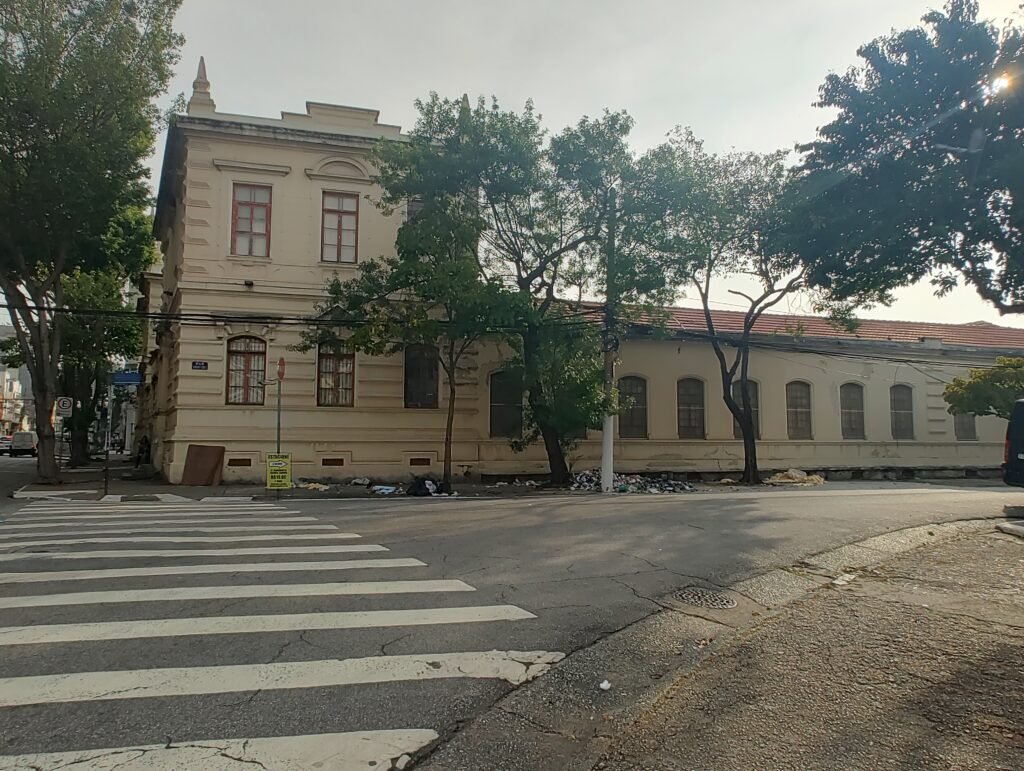
Image: Antonella Delmonte Allasia. Street next to the Emílio Ribas Public Health Museum in Bom Retiro, covered in rubbish.

Explore More on This Topic

📖 Viver e morrer em São Paulo: Imigração, saúde e infraestrutura urbana (século XIX até o presente), by Jeffrey Lesser (Brazilian edition, Editora da Unesp,  2025)

🎧 Dois Pontos (ep. 7): “Saúde, migração e o SUS: desafios e caminhos” (interview with Eugenia Brage, PAGU-Unicamp / Mecila)

🎧 Diálogos Mecila (ep. 20): “’El Alto no Brasil’. Migración y convivialidad en São Paulo” (interview with Gabriel Mamani Magni with Antonella Delmonte Allasia)

📖 Antonella Delmonte Allasia, “Costurar formas de vida y convivialidad. Reflexiones sobre el trabajo de mujeres migrantes en São Paulo más allá de la informalidad(Mecila Working Paper Series, No. 88)

📖 Eugenia Brage, “Tramas populares-comunitarias de convivialidad. Reflexiones en torno a la sostenibilidad de la vida y la producción de lo común en contextos transfronterizos” (Mecila Working Paper Series, No. 72)

#47

Mecila Information Infrastructure: A Digital Network for Scientific Collaboration in Latin America and Europe

The Ibero-Amerikanisches Institut Editorial Team

The Mecila Information Infrastructure connects researchers from Latin America, Europe, and German-speaking countries through a shared digital platform. With the Mecila eLibrary and comprehensive access to scholarly resources, interdisciplinary research on culture, society, and politics in Latin America is supported sustainably. The Mecila Institutional Workshop from February 18 to 20, 2026, in Berlin offers insights into the use and future development of the infrastructure, a key pillar of the Mecila research network.

The Mecila Information Infrastructure stands as a cornerstone of academic and cultural exchange between Germany and Latin America. Developed in close collaboration with leading institutions across the region, including the Daniel Cosío Villegas Library of El Colegio de México (COLMEX, Mexico), the Library of the Instituto de Estudos Brasileiros at the University of São Paulo (USP, Brazil), and the Biblioteca Prof. Guillermo Obiols of the Facultad de Humanidades y Ciencias de la Educación, Instituto de Investigaciones en Humanidades y Ciencias Sociales (IdIHCS–CONICET/Universidad Nacional de La Plata, Argentina). The Mecila Information Infrastructure supports the interdisciplinary research network of the Mecila Project, funded by the Bundesministerium für Forschung, Technologie und Raumfahrt (BMFTR) and coordinated by the Ibero-Amerikanisches Institut (IAI) in Berlin (Germany).

Since its inception, Mecila has brought together scholars from diverse fields to examine pressing social transformations in Latin America, from urbanization and migration to cultural identity and political change.

For researchers working at the Mecila Hub in São Paulo or from distant academic centers, access to specialized literature can be a persistent challenge. The Mecila Information Infrastructure addresses this by creating a unified digital ecosystem that bridges geographical and institutional divides. Far more than a mere digital library, it functions as a cohesive knowledge infrastructure, integrating physical and digital resources, enabling seamless access to rare and hard-to-obtain materials, and fostering a shared research environment across continents.

At the core of this infrastructure is the Mecila eLibrary, a secure, virtual reading room designed specifically for copyrighted print materials that are not available in digital form. Access is restricted to registered Mecila project members and provided in compliance with German copyright law, ensuring legally compliant and equitable access to the materials. As of early 2025, the eLibrary hosts over 330 digitized titles, all selected from the Ibero-Amerikanisches Institut’s (IAI) extensive print holdings and curated for relevance to Mecila’s research themes. The collection includes works in English, Portuguese, and Spanish, covering a broad spectrum of social, cultural, and political topics central to the project.

Access to the Mecila Information Infrastructure is straightforward and free for all project members, including fellows, doctoral researchers, principal and associated investigators, and scientific coordinators. After personal registration, users are granted access to the services of the infrastructure, including the Mecila eLibrary, as well as to all digital resources of the IAI. While the eLibrary offers targeted access to digitized monographs, the Mecila Information Infrastructure provides users with access to the catalogues and services of all participating partner libraries. This includes the Online Public Access Catalogue (OPAC) and digital services of the Ibero-American Institute (IAI), as well as those of the Daniel Cosío Villegas Library at El Colegio de México (Mexico), the Library of the Institute of Brazilian Studies at the University of São Paulo (Brazil), and the Professor Guillermo Obiols Library of the Facultad de Humanidades y Ciencias de la Educación / IdIHCS at the Universidad Nacional de La Plata (Argentina). These resources, combined with the ability to request digitization of specific materials, ensure that researchers can access the scholarly foundations they need, regardless of location.

Looking ahead, the Mecila Information Infrastructure will be further strengthened through a Mecila Institutional Workshop in Berlin from February 18 to 20, 2026, bringing together researchers, librarians, and technical coordinators to evaluate current practices, discuss future developments, and enhance the platform’s usability. This event underscores the Mecila Information Infrastructure’s role not only as a repository of knowledge but as a living, evolving space for collaboration that reflects the dynamic, transnational nature of contemporary research in Mecila and the Ibero-American world. By integrating institutional expertise, digital innovation, and a commitment to equitable access, the Mecila Information Infrastructure exemplifies how modern research infrastructures can transcend borders, enabling scholars to work together, share insights, and advance understanding across continents.

Mecila Information Infrastructure: Quick Overview

  • Project: Mecila Research Network (DFG-funded)
  • Coordinated by: Ibero-Amerikanisches Institut (IAI), Berlin
  • Partner Libraries:
  • COLMEX (Mexico)
  • USP (Brazil)
  • IdIHCS, CONICET/UNLP (Argentina)
  • Access: Free for all Mecila project members
  • Core Service: Mecila eLibrary: virtual reading and research space
  • Additional Services: Digitization requests, library card, technical support
  • Upcoming Event: Mecila Institutional Workshop, February 18–20, 2026, Berlin

You might also be interested in:

Contact:

Dr. Christoph Müller, PI and Coordinator of Mecila Information Infrastructure, IAI Library: mecila.library@iai.spk-berlin.de

#46

Rethinking Whiteness in Latin America: New Dialogues on Race and Inequality

Benjamin Junge (Mecila Senior Fellow / SUNY)

By combining essays on the origins of “whiteness” as a conceptual framework with studies of urban gentrification, and neoliberal capitalism, the sixth volume in the Mecila-CLACSO book series shows us that whiteness in Latin America is simultaneously old and new: It has deep colonial roots yet is constantly reinterpreted in contemporary contexts.

What does it mean to study whiteness in Latin America, and why refer to branquitudes and blanquitudes in the plural? The newest publication in the Biblioteca Mecila series, Branquitudes/Blanquitudes: Diálogos latinoamericanos sobre convivialidad y desigualdad, brings together Latin American scholars to explore these questions. Organized by Mário Augusto Medeiros da Silva, Patricia de Santana Pinho, Roosbelinda Cárdenas, and Hugo Cerón-Anaya, the book is both a collective intervention in whiteness studies and a call for dialogue across languages, regions, and intellectual traditions.

The volume’s editors push against the idea that whiteness is a single, fixed thing, but rather takes diverse, historically specific, and sometimes contradictory forms. The terms “branquitude” and “blanquitud” have emerged in Portuguese and Spanish to name these processes, drawing attention to structural and experiential dimensions of racial privilege. By combining essays on the origins of “whiteness” as a conceptual framework with studies of urban gentrification, and neoliberal capitalism, the volume shows us that whiteness in Latin America is simultaneously old and new: It has deep colonial roots yet is constantly reinterpreted in contemporary contexts.

Crédito: Mônica Cardim: Retratos contra a pele.

“Whiteness studies” established itself as a field of study in the United States in the 1990s. But can the conceptual frameworks developed in that context be applied to Latin America and other world areas? From colonial legacies of Iberian rule, to national myths of mestizaje, to the tendency to foreground class and downplay race in sociological analysis, the political, historical, and cultural dimensions of race in Latin America differ significantly. Accordingly, Branquitudes/Blanquitudes positions itself as a regional conversation that both dialogues with and departs from the Anglophone canon. The plural in the title signals something important: There is no singular, objective whiteness to investigate. Rather, the volume’s essays show how whiteness operates differently across time, space, and scale: as ideology, as privilege, as aspiration, and as embodied practice.

Several chapters draw on history to understand how whiteness took root and operated before it acquired a name. Patricia Martins Marcos analyzes Portuguese colonial contexts to argue that whiteness existed long before the concept of “branquitude” emerged. Mário Augusto da Silva shows how Black intellectuals in Brazil from 1945 to 2000 made whiteness visible through critique, even as mainstream scholarship ignored it. Critical thinking about whiteness in Latin America, he shows, didn’t simply appear following the arrival of theory from the global north: it had long been cultivated by Black thinkers themselves. Patricia de Santana Pinho tracks the trajectory of “branquitude” in Brazilian scholarship between 2000 and 2025. Her chapter isn’t only a history of a concept: It gives us a map of an emergent field. She shows how affirmative action debates, the Movimento Negro, and shifting political winds have pushed whiteness studies onto the center stage of Brazilian academia.

Crédito: Mônica Cardim: Retratos contra a pele.

Other chapters reframe and “provincialize” whiteness studies. Verónica Cortés Sánchez shows how scholarly perspectives from Latin America have produced “(re)readings of whiteness.” She asks: What is gained – and what risks are obscured – by the dominance of Anglophone genealogies in the field? Similarly, Cárdena’s chapter proposes the notion of “blanquigrafías hemisféricas” as a method to “write whiteness” across the hemisphere by tracing continuities in racialization, colonization, and capitalism.

The volume’s later chapters bring whiteness into the urgent contemporary moment, focusing on how whiteness reproduces inequality in everyday urban and social life. In her chapter, Ana Y. Ramos-Zayas shows how neoliberal capitalism and whiteness are mutually constitutive, producing not just economic inequality but moral structures for how one is recognized as a “good” citizen, a reliable worker, or a desirable neighbor. Grimaldo-Rodríguez’s chapter addresses gentrification, showing how urban transformation displaces communities of color yet normalizes white spatial dominance. Cerón-Anaya’s chapter argues that whiteness can’t be understood apart from gender and class; hence, the importance of intersectionality not as an “add-on,” but rather a methodology of study in its own right.

Crédito: Mônica Cardim: Retratos contra a pele.

For readers unfamiliar with Latin American debates, Branquitudes/Blanquitudes both shows how  whiteness shapes inequality and conviviality in the region. But as importantly, it also carves out space for Latin American scholarship to speak on its own terms. It also signals (and embodies) the importance of interdisciplinary empirical work and theory-building. The volume brings us several major insights. First, whiteness is always relational and it always relies on structures of exclusion and hierarchies of recognition. Second, whiteness is never static, but rather adapts dynamically to neoliberal economies, migratory flows, and shifting cultural imaginaries. Third, whiteness is always also affective, embodied, and aspirational.

As a whole, this important volume invites us to think whiteness differently – to see it not as a ready-made conceptual paradigm borrowed from the North, but rather as a tangle of practices, histories, and power relations that demand closer atention. The stakes here are not merely academic as – in Latin America and beyond – whiteness remains a powerful yet invisible force in everyday life. Branquitudes/Blanquitudes offers us generative perspectives on naming whiteness, studying whiteness, and contesting whiteness – so that more equitable forms of life together become imaginable.

#40

Divulgação científica no Brasil: desafios e avanços rumo à democratização do conhecimento

Global Convivial Forum 

Melanie Metzen (Events and Outreach Coordinator)

Evento de Divulgação Científica da Fiocruz Brasília reuniu especialistas para debater políticas públicas, inclusão e estratégias para fortalecer a comunicação da ciência no país.


Entre os dias 13 e 15 de agosto de 2024, a Fiocruz Brasília promoveu a 2ª Semana de Divulgação Científica, reunindo pesquisadores, professores e comunicadores em um esforço coletivo para fortalecer a divulgação científica no Brasil. Pude participar do evento que teve como objetivos fomentar políticas públicas para a área e desenvolver estratégias para enfrentar desafios contemporâneos, como o negacionismo e a desinformação.

Uma das questões centrais do encontro foi a análise das iniciativas conduzidas por instituições como a Fiocruz, a Fapesp, o CNPq e o Ministério da Ciência, Tecnologia e Inovação (MCTI) nos últimos anos, bem como a construção de perspectivas futuras para a divulgação científica no país. Desde a pandemia de COVID-19, observa-se um crescimento no investimento e na visibilidade das iniciativas de comunicação da ciência. Entretanto, esse movimento enfrenta desafios estruturais e institucionais, que exigem soluções coordenadas.

FioCruz1

Mesa de abertura 2ª Semana de Divulgação Científica. Imagem: Sérgio Velho

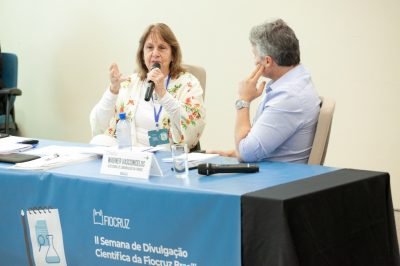
Graça Caldas, professora e pesquisadora do Labjor/Unicamp e Wagner Vasconcelos da assessoria de comunicação, Fiocruz Brasília. Imagem: Sérgio Velho


Diante de um cenário em que apenas 21% da população brasileira concluiu o ensino superior e menos de 1% possui pós-graduação, torna-se fundamental democratizar o acesso ao conhecimento. As instituições de pesquisa não apenas produzem conhecimento, mas também têm a responsabilidade de traduzi-lo e disseminá-lo para diferentes segmentos da sociedade. A popularização da ciência deve ser compreendida como parte essencial da missão acadêmica, promovendo a alfabetização científica e ampliando o diálogo com públicos diversos.

Na conferência de abertura, Juana Nunes, diretora de Popularização da Ciência, Tecnologia e Educação Científica da Sedes/MCTI, destacou a necessidade de estruturar políticas nacionais para a divulgação científica, a fim de coordenar e potencializar os investimentos na área. Um dos desafios apontados foi a fragmentação do sistema de ensino superior no Brasil, que conta com instituições federais, estaduais e privadas frequentemente operando de maneira isolada e competitiva, dificultando a integração de esforços.

A diversidade também emergiu como um elemento crucial na discussão sobre a comunicação da ciência. A ampliação do alcance da divulgação científica para populações em situação de vulnerabilidade social e econômica é um passo essencial para garantir inclusão étnico-racial e de identidade de gênero. Não basta tornar a produção acadêmica disponível; é preciso construir pontes eficazes entre o conhecimento e a sociedade, de forma a torná-lo acessível e relevante.

FioCruz2


Um dos debates mais instigantes do evento ocorreu na mesa “Divulgação Científica em Tempos de Negacionismo”, com participação da pesquisadora Graça Caldas, do Laboratório de Estudos Avançados em Jornalismo (Labjor/Unicamp). Caldas ressaltou a necessidade de repensar modelos tradicionais de comunicação científica que dependem de intermediários, como jornalistas, editoras e revistas especializadas. Segundo a pesquisadora, uma das tendências observada nos últimos anos – o fortalecimento da presença digital de cientistas e instituições – pode ser um caminho para ampliar o alcance e garantir interação direta com o público, reduzindo a dispersão de informações.

Luis Amorim (Museu da Vida), durante sua participação da mesa “A ciência, a arte e o lúdico”, também destacou o fato de que a pesquisa sobre comunicação científica no Brasil ainda está em processo de consolidação e carece de um referencial teórico mais robusto. Embora existam programas de mestrado na área, como os oferecidos pelo LabJor/Unicamp e pela Fiocruz, ainda não há cursos de doutorado específicos em divulgação científica, o que limita a formação avançada de especialistas.

Outro desafio apontado foi a carência de metodologias mais robustas para avaliar o impacto das iniciativas de comunicação científica no Brasil. Essa lacuna metodológica reforça a necessidade de uma política estruturada e de maior investimento na área. No entanto, avanços já podem ser observados: atualmente, o CNPq exige a inclusão de um plano de comunicação como parte dos projetos de pesquisa financiados pela agência, um passo fundamental para integrar a divulgação científica ao processo de produção do conhecimento.

Ao refletirmos sobre o futuro da divulgação científica, torna-se evidente que sua consolidação depende de um esforço contínuo de fortalecimento institucional, capacitação de profissionais e construção de políticas públicas eficazes. Somente com uma abordagem estruturada e integrada será possível garantir que o conhecimento científico cumpra seu papel social e contribua para uma sociedade mais informada e participativa.

Diante desse cenário, as iniciativas de comunicação científica do Mecila ilustram a importância de estratégias contínuas e adaptáveis. Desde 2018, o centro tem investido em diferentes formatos de disseminação do conhecimento, passando por um processo de aprendizado constante e ajustes estratégicos. A aposta em tecnologias digitais, como podcasts, newsletters, um site multilíngue e comunicação ativa em redes sociais, tem permitido alcançar públicos diversos. Além disso, parcerias institucionais, como com o Conselho Latino Americano de Ciências Sociais (CLACSO), e a publicação de working papers em conjunto com o Instituto Iberoamericano de Berlim, reforçam o compromisso do centro com a democratização da ciência. Esses esforços demonstram como a comunicação científica pode ser aprimorada por meio da experimentação de formatos não tradicionais, contribuindo para aumentar o alcance e acessibilidade dos resultados de pesquisa.

#39

Putting Care on the Political Agenda: International Symposium Care that Matters, Matters of Care

Global Convivial Forum 

Raquel Rojas (Postdoctoral Investigador, Mecila-FU Berlin)

Roundtable: Care and Inequalities Across Time and Space with Barbara Potthast, Encarnación Gutiérrez-Rodríguez, Nadya Araujo Guimarães, Karina Batthyány and Raquel Rojas

The International Symposium Care that Matters, Matters of Care provided a unique platform to rethink the place of care in our societies. By bringing together experts from diverse fields and countries, it reaffirmed the critical role governments — within the G20 and beyond — must play in addressing care inequalities and building a just, equitable social organization of care.


Care is the foundation of human existence, yet it has historically been undervalued and relegated to the private sphere, disproportionately burdening women and girls. Feminist movements have long sought to bring care into the political realm, and recent years have seen significant progress, particularly in Latin America. A notable example is its inclusion in the G20’s latest discussions.

The International Symposium Care that Matters, Matters of Care took place on October 14–15, 2024, at the University of São Paulo (USP). Organized as part of Brazil’s G20 Presidency and the T20 discussions, it was hosted by Mecila with support from DWIH São Paulo and USP’s International Cooperation Office (Aucani). The event brought together researchers, policymakers, and civil society representatives to discuss care policies as tools for addressing intersecting inequalities.

The symposium began with a welcome address featuring Nina von Sartori (German Embassy in Brasília), Sérgio Proença (Aucani), Adrián Lavalle (CEBRAP), Marcio Weichert (DWIH São Paulo), and Sérgio Costa (Mecila). The opening roundtable examined the interplay between care and inequalities, exploring its historical roots and global connections. Barbara Potthast (University of Cologne) discussed key aspects of the social organization of care in Latin America over time. Nadya Araujo Guimarães (USP) highlighted the region’s contributions to conceptualizing care and developing the field. Karina Batthyány (CLACSO/UdelaR) presented insights into Uruguay’s Sistema Nacional Integrado de Cuidados, the first care system in the region, showcasing its successes and challenges, and Encarnación Gutiérrez-Rodríguez (University of Frankfurt) explored the interconnections between care regimes in Europe and Latin America, emphasizing care chains and migration.

DSC_0219


The second day began with the panel “Making Care Visible,” which focused on care’s diverse aspects across life cycles and social structures. Priscila Vieira (CEBRAP) discussed elder care in São Paulo, highlighting caregivers’ physical and emotional burdens, social isolation, and mistrust of the state. Eugenia Rausky (CONICET/UNLP) offered an anthropological perspective on childhood, revealing how children in lower-income households often provide care, challenging traditional narratives of children as solely care recipients. Talja Blokland (Humboldt University) addressed the complexities of state care programs, emphasizing the tensions between trust-building with beneficiaries and bureaucratic professionalism. Landy Sánchez (El Colegio de México) presented an innovative analysis of how climate change exacerbates care crises, spotlighting the intersection of two global challenges. Commentators Luiza Nassif Pires (UNICAMP) and Eugenia Brage (CONICET/PAGU) enriched the discussion, bridging diverse perspectives.

A subsequent panel explored strategies to politicize care and the impact of the COVID-19 pandemic in exposing inequalities. Raquel Rojas (FU Berlin) and Laura Flamand (El Colegio de México) presented a comparative study of impacts of the pandemic on inequalities, emphasizing the effects of diverse care provision models. Eryka Galindo (University of Heidelberg) examined the pandemic’s impact on food security in Brazil, linking household-level care to public policies and multinational corporate practices. Regina Vieira (UNIFESP) addressed the challenges of adapting global care policy indexes to heterogeneous contexts, while Jana Silverman (UFABC) highlighted the struggles and resilience of Brazil’s domestic workers, a key pillar of care provision in the region. Discussants Miriam Nobre (Siempreviva Organização Feminista) and Izadora Xavier do Monte (Mecila) provided critical perspectives on these issues.

DSC_0263

Panel I: Making care visible with Priscila Vieira, María Eugenia Rausky, Talja Blokland, Landy Sánchez, Bianca Tavolari, Luiza Nassif Pires and Eugenia Brage


The final panel explored policy approaches in Latin America to recognize and redistribute care responsibilities. Mariana Mazzini Marcondes (Secretaria Nacional da Política de Cuidados e Família) shared Brazil’s experience advancing a care policy through active civil society participation. Laura Pautassi (CONICET/UBA) emphasized the importance of recognizing care as a universal right and shared regional milestones toward this goal. Patricia Cossani Padilla (UN Women) highlighted the need to integrate care into normative frameworks to ensure sustained progress beyond political cycles. Closing remarks by Guita Grin Debert (UNICAMP) and Lorena Hakak (FGV RI) underscored the importance of embedding care as a transversal element in public policy.

Overall, the International Symposium Care that Matters, Matters of Care provided a unique platform to rethink the place of care in our societies. By bringing together experts from diverse fields and countries, it reaffirmed the critical role governments—within the G20 and beyond—must play in addressing care inequalities and building a just, equitable social organization of care.

Mecila researchers also had the opportunity to meet with Germany’s Federal Minister for Family Affairs, Senior Citizens, Women and Youth, Lisa Paus, who attended the G20 Gender Equality Ministerial Meeting in Brasília in early October. Their discussions focused on the outcomes of the International Care Symposium and highlighted the urgent need for states to work towards a more equitable distribution of care and the contributions of academia to this task.

Watch the whole event now on the Mecila YouTube channel.


Images by Vitória Zandonadi and Iris Brochsztain.

#38

Restitution of sacred Kogui masks, June 2023. Photo: Colombian Presidency on X (@infopresidencia)

A Latin American Restitution Monitor: Tracking and Documenting Restitution Efforts for Cultural Belongings and Ancestral Remains in Latin America

Global Convivial Forum 

Julia von Sigsfeld (Mecila Junior Fellow, 2024)

Even though debates on restitution have gained more visibility and become more widespread on an international scale in the past decade, there remains a significant gap when it comes to Latin America: the absence of a comprehensive overview of restitution cases demands, not to mention a system to monitor restitution.


Demands for the restitution of cultural items and the repatriation of ancestral remains Latin America have been ongoing for decades. Over the years, these efforts have taken different forms, and within the global spotlight now on heritage restitution and the, these issues may gain even greater importance in the near future. 

Claims for the repatriation of ancestral remains of members of Mapuche and Tehuelche communities taken to museums – primarily the Museo de La Plata – following the military campaign of territorial expansion and Indigenous genocide led by the Argentine government in the late 19th century, have been raised at least since the 1970s in Argentina. In the 1980s, the Krahô people requested the restitution of a decades-long missing kàjré, a sacred ritual ceremonial stone axe. It was given to São Paulo’s Museu Paulista in the 1940s by a German ethnologist. In 1988, a Moai that had been removed and transferred to Oslo’s Kon Tiki Museum in the 1950s was returned to Rapa Nui after having been requested back by the Council of Elders. To name a more recent case, in 2022 an agreement was reached to restitute the Maaso Kova, a sacred ceremonial deer head, in the hands of Stockholm‘s Museum of Ethnography to the Yaqui Nation after the Yaqui requested an intervention by the Expert Mechanism on the Rights of Indigenous Peoples (EMRIP) in 2018 given that their 2003 restitution request had initially been denied.

Descriptions of these varied cases can be found in a number of enlightening publications which sometimes focus in an in-depth manner on single restitution processes and sometimes provide overview of cases, even going beyond individual national contexts. They demonstrate how restitution processes in Latin America are highly diverse as they are tied to concrete moments as well as broader historical processes of dispossession tied to nation-building processes, missionary work, scientific exploitation but also to processes of conscientization, identity and community (re-)constitution as well as struggle for rights, territories, recognition, and self-determination.

6.Aquarela-sobre-pergaminho-autor-desconhecido-sec-XVI-768x432


Tracking Restitution Cases

There are some noteworthy resources and platforms that track restitution efforts with distinct regional and thematic foci. These efforts provide important precedents and inspiration. These span from the online platform Open Restitution Africa which provides information and research on restitution cases to Africa centring African voices in the debate, to the website Returning Heritage which offers news on cultural heritage restitution and some information by country, to the recently established German Restitution Monitor featured on the Blog Dekolonial Erinnern that tracks updates on open restitution cases in Germany.

Such overviews provide valuable information with regards to past restitutions and open cases next to fostering transparency and accountability in restitution efforts. As such they serve as valuable resources to not only claimants and interested stakeholders as well as researchers accompanying or following restitution processes, but every person interested in the issue of restitution. What is more, such initiatives are essential in keeping restitution efforts visible and ensuring that commitments to return cultural belongings or ancestral remains are fulfilled.

Fzu5MH9X0BwTPCx-696x464


The Need for an Overview or Monitoring System

Whereas one can find a great number of insightful publications on restitution cases, for the Latin American region such an overview is still missing. There is also a lack of a system to monitor restitution efforts. A Latin American restitution monitor could constitute a valuable resource for tracking demands for the return of cultural belongings and ancestral remains, mapping resolved and ongoing cases. Such an overview would provide much-needed transparency and visibility.

The absence of such an overview means that researchers and activists lack a tool to readily track, assess, compare, and analyse the progress and challenges of restitution efforts in the region – beyond individual national contexts and beyond information retrieved from single academic publications, individual news segments, or institutional/museum outreach sources. A dedicated monitor could fill this gap, providing a much-needed resource for assessing and analysing the progress and challenges of restitution efforts for stakeholders engaged in restitution efforts, museum professionals, activists and researchers as well as a general public interested in restitution processes.

As one can gather from disparate sources, in some cases, state actors and governmental bodies have taken an active role in negotiating with foreign institutions and governments, while in others, Indigenous communities, civil society organizations, and cultural advocates have been at the forefront. Community efforts span from national and international advocacy for restitution/repatriation to direct struggles against state ownership of and control over cultural belongings and ancestral remains. In the absence of legal frameworks that guarantee a right to restitution/repatriation, aside from the Argentinian repatriation law 25.517 from 2001, this diversity in cases and approaches reflects the varied political, cultural, and historical landscapes and the panoramas of collective/Indigenous rights of Latin American countries. The monitor would allow for a sustained comparative analysis across different countries and institutions, offering background information and insights. What is more, it would help record the arguments put forth and the difficulties encountered, thereby allowing the identification of best practices. 

Ultimately, greater visibility would foster transparency and accountability from institutions and private entities holding belongings and ancestral remains, as well as Latin American states who are still lacking behind in fulfilling the call of the 2007 UN Declaration on the Rights of Indigenous Peoples (UNDRIP) to work with Indigenous nations and communities toward developing effective restitution mechanisms. All in all, a restitution monitor for Latin America would aid those advancing efforts to reclaim cultural belongings and ancestral remains, providing the data necessary to inform ongoing and future restitution initiatives.

Developing a Platform

The project could be of various scales. Rather than collecting cases in a report, to be adaptable, amendable and expandable upon, initially, a monitor could begin with an overview on a website that can be corrected as well as regularly updated and expanded. This could serve as the foundation for a larger initiative involving more in-depth research aimed at documenting restitution cases and demands. Ideally, a broader platform could include survey data of institutions capturing information on both accepted and rejected cases. It could furthermore provide a space for the collection of resources on each case, featuring not only information material but be expanded upon with testimonials or even interview video material. There is also potential for expanding the project beyond Latin America to the Caribbean, where ongoing efforts to create inventories, for instance, have been already under way.

Collaboratively working on and expanding this initiative would be crucial to create a dynamic, living archive that reflects the complexity and ongoing nature of this effort of long duration that is restitution. Establishing partnerships would be essential to maintain a dynamic, adaptable platform that reflects the evolving landscape of restitution cases and finding funding and support would be crucial to develop this resource, enabling it to grow and effectively document restitution.

#37

Tiago Oliveira (Guarani Nhandewa)

Reclaiming Heritage: The Role of German Ethnologists and Collections for Brazilian Indigenous Memory and Rights

Global Convivial Forum 

Roberta Hesse (Mecila / FU Berlin / PPGAS-USP)

The workshopPeople, Objects and Ideas Circulation: Transnational Entanglements between Brazil and Germany”, held in the context of the 200th anniversary of German-speaking people’s immigration to Brazil, offered a fresh perspective to reflect upon the relations between Brazil and Germany. 

Ubiratã Gomes (Tupi)

In 2024, the Bicentennial of the Immigration of German-speaking people to Brazil is being celebrated. In this context, Mecila, alongside the Museum of Archaeology and Ethnology (MAE/USP) and the Centre for Amerindian Studies from USP (CEstA/USP), organised the workshop “People, Objects and Ideas Circulation: Transnational Entanglements between Brazil and Germany” on March 28th. Hosted by the Museu de Arqueologia e Etnologia (MAE/USP) and coordinated by Dr Barbara Göbel (IAI / Mecila) and myself, the workshop brought together Indigenous leaders and scholars, as well as non-Indigenous scholars, to discuss the role of German ethnologists conducting research in Brazil in the nineteenth and early twentieth centuries and the significance of the collections and knowledge gathered by them for current Brazilian Indigenous groups. A key highlight of the discussion was that despite the importance of these collections for Indigenous groups, they still face significant difficulties in accessing them.

The first panel provided a critical reflection on the contributions of German ethnologists such as Karl von den Steinen, Paul Ehrenreich, Max Schmidt, Theodor Koch-Grünberg, and Curt Unckel Nimuendajú. On the one hand, the discussion highlighted that these ethnologists, motivated by pessimistic romanticism, sought to document the linguistic, material culture, and myths of Indigenous groups they believed were on the brink of extinction or assimilation. On the other hand, Tiago Oliveira (Guarani Nhandewa) (PPGAS-USP), an Indigenous leader and scholar whose ancestors adopted and hosted for many years Curt Unckel Nimuendajú, emphasized how the objects and knowledge gathered by these ethnologists can serve as powerful tools for contemporary Indigenous groups in their efforts to reclaim their memories, languages, myths, and legal rights to territories.

Dr Erik Petschelies (UFRJ) provided an overview of the expeditions conducted by these German ethnologists, discussing their outcomes, and generational differences. He focused on their legacy for Brazilian ethnology and Indigenous policymaking by the state. Karl von den Steinen led the first major expedition to the upper Xingu River region in 1884 and a second in 1887-1888, resulting in an important linguistic classification of the different groups in the area. Paul Ehrenreich conducted an expedition to the Doce River region in 1885 and two others to the Araguaia and Purus rivers in 1888-1889, gathering significant myths from these areas. Theodor Koch-Grünberg undertook two major expeditions, the first to the Negro River region and the second from Roraima to the Orinoco River, compiling a significant collection of myths, that inspired the well-known Macunaíma novel by Brazilian modernist Mário de Andrade. Max Schmidt conducted three main expeditions in Brazil (1900-1901; 1910; 1926-1928) and developed a notable social theory about the Aruak-speaking groups’ relations with other Indigenous-speaking groups, marked by a significant Aruak expansion through economic interdependency, termed “aruakisierung” by the author. It was noted that these ethnographic descriptions and theories suggest a form of emic acculturation practice, not linked to colonialism, wherein different Indigenous groups, with limited contact, had an intensive cultural exchange among themselves. Nevertheless, the impact of these works on German-Brazilian ethnologists such as Herbert Baldus and Egon Schaden, and their influence on Brazilian policy towards Indigenous groups, often had harsh consequences. The romantic legacy played a harmful role, fostering the public perception that in many regions Indigenous groups no longer existed. This perception significantly influenced the policies implemented by the Serviço de Proteção aos Índios (SPI), the Brazilian state agency responsible for Indigenous affairs at the time.

WhatsApp Image 2024-06-26 at 17.45.07 (1)

Belonging to a group strongly affected by this perception of assimilation, Tiago Oliveira (Guarani Nhandewa), was raised in an Indigenous community named after the ethnologist Nimuendajú, within the state-recognized Terra Indígena Araribá in western São Paulo state. He explained how the book Die Sagen von der Erschaffung und Vernichtung der Welt als Grundlagen der Religion der Apapocuva-Guarani (1914), by Curt Unckel Nimuendajú, translated into Portuguese in 1987, inspired him to start his career as a researcher. The ethnographic data recorded by Nimuendajú enabled Oliveira, and many other Indigenous school teachers and leaders, to revisit and reconstruct their stories, myths, language, customs, and rituals, which had been suppressed by the state for decades. A strong example he mentioned was how Nimuendajú’s collected kinship data and photographs allowed him to trace his ancestors’ paths, which had been erased or lost from official state documentation. Despite Nimuendajú’s romantic background, Oliveira positively assesses his legacy, as the rich ethnographic data now serves as both inspiration and a source for Indigenous professors reclaiming their stories, myths, and rituals.

The workshop’s second panel delved into the ethnographic collections owned by German institutions and the implications of the circulation of these objects. Dr Maria Luisa Lucas (MAE-USP) presented her research on the collection from Carl Friedrich von Martius and Johann Baptist von Spix, currently owned by the Five Continents Museum in Munich. Through analysing objects and photographs, she encouraged the audience to reflect on how these items produced images of savagery and civilization and suggested that a new perspective on the collections could reveal hidden relationships between different Indigenous groups. While at the collection, she noticed that an object catalogued as belonging to a Witoto-speaking group seemed more characteristic of a Tukano-speaking group, a discrepancy the collection curators acknowledged. The Witoto and Tukano groups lived very far apart, with no known extensive relationship between them. One possible explanation is a simple cataloguing error by von Martius and Spix. However, a more intriguing possibility is that the object’s presence in a Witoto-speaking community indicates a historical exchange and circulation network between these distant groups. This speculative scenario suggests that objects in such collections can serve as historical documents, narrating alternative histories and deepening anthropological and historical understandings.

The panel also addressed the significant challenges Indigenous groups face in accessing these collections and documents. Dr Luisa Valentini (CEstA-USP) conducted an exercise to reflect on what a Kamayurá person might be able to locate from their people’s collections in German institutions. She highlighted numerous barriers, including language obstacles, as most institutional websites are available only in German and English, not Spanish or Portuguese. Additionally, many online catalogues are incomplete, with numerous objects lost during World War II or listed under broad categories like “America.” Furthermore, academic articles and lists about these collections were mostly produced by visiting Brazilian or Latin American scholars, not the institutions themselves. Indigenous partners reported difficulties in getting responses from institutions or even not being properly welcomed to visit the collections. Dr Valentini concluded that, despite current debates about restitution, co-curatorship and participation, Brazilian Indigenous groups remain dependent on well-connected brokers to reach these important collections.

WhatsApp Image 2024-06-26 at 17.53.58

Finally, Ubiratã Gomes (Tupi) (FUNAI / UNISANTOS), an Indigenous leader and an employee at the Brazilian Fundação Nacional do Índio, the current state agency for Indigenous affairs, shared his experiences with documents, reports, objects, and the university. He criticized the severe consequences of misconceptions made by authors like Egon Schaden, who spent less than a week with his group. These misconceptions supported silencing actions by the SPI such as homogenizing various Tupi-Guarani speaking groups into a single category, «Guarani”. Until the 1988 Brazilian Constitution, Gomes’ people were considered Guarani-Nhandewa by the state, and they still struggle for recognition as a distinct Tupi people group. Despite the obstacles he faced in accessing higher education, through his research he managed to reconnect important traces of his people and locate a significant collection about his people abroad. He argued that these collections should not necessarily be repatriated to Brazil, but rather be well-maintained by the institutions, with guaranteed visiting policies for the groups to which they belong.

By bridging past and present, the workshop highlighted how the objects and knowledge collected by German ethnologists can support Indigenous groups in reclaiming their heritage and asserting their rights, if they manage to access them. The insights gathered during the workshop pointed to the essential role of collaboration and accessibility policies for respecting and honouring these very lively groups.

#36

Lições do Zócalo

Global Convivial Forum 

Samuel Barbosa (USP / Mecila)

A Cátedra Mecila permitiu uma imersão na rica cultura mexicana. Fui introduzido a uma bibliografia do maior interesse para minhas pesquisas, conheci ativistas e pesquisadores de diversas instituições do México, explorei arquivos, aprendi com a história pública dos monumentos, museus, templos e festas.

Conferência de Paulo Freire. Arquivo CIDOC/Colmex

Projeto de Pesquisa sobre Aspectos Jurídicos e Sociais da Propriedade da
Terra na América Latina de Francisco Julião. Arquivo CIDOC/Colmex

ruy (1)
orden (2)

Fiz a fotografia para fins de registro em minha viagem à Cidade do México em fins de 2023. É do mural de Diego Rivera, Los sabios (1928), que se encontra no segundo andar da Secretaría de Educación Pública (SEP). O edifício foi um convento colonial. Com o fim da Revolução Mexicana, foi transformado em prédio de governo pelo secretário José Vasconcelos durante o governo de Álvaro Obregón (1920-1924). Seria o jurista Ruy Barbosa um dos representados por Rivera?

Outra surpresa foi encontrar a inscrição positivista “Orden y Progreso”, bem conhecida dos brasileiros, no Antigo Colegio de San Ildefonso que foi dos jesuítas e, em 1867, no governo de Benito Juárez, se converteu na Escuela Nacional Preparatoria, laica, pública e propriedade do Estado. Mais um indício do que pode ligar Brasil e México?

Questões como essas surgiram da minha estadia como pesquisador-visitante no El Colegio de México, entre outubro e dezembro de 2023, no âmbito da Cátedra Mecila.

A Cátedra é um dos instrumentos de colaboração científica da fase principal do Mecila. Possibilita a circulação de pesquisadores entre as instituições da América Latina que criaram o Centro. Pesquisadores permanentes, que trabalham em uma das instituições latino-americanas (USP, Cebrap, Colmex, UNLP), recebem o apoio para um período de pesquisa de até dez semanas em outra instituição do consórcio.  

Entre os meus compromissos, estava ministrar uma Distinguished Lecture, no âmbito do Seminario permanente Derecho y Sociedad (Colmex), coordenado por José Ramón Cossío e Humberto Beck, que recebeu comentários de Érika Bárcenas (UNAM). Apresentei uma crítica ao conceito de pluralismo jurídico, que tem ampla circulação nas ciências sociais na América Latina, e o conceito alternativo de multinormatividade. O segundo compromisso foi participar do International Workshop Indigenismos en América Latina II que contou com a presença de pesquisadores do Colmex, de outras universidades mexicanas e do exterior, e de lideranças indígenas. Apresentei uma comunicação sobre o regime jurídico dos povos indígenas e tradicionais no Brasil pós-ditadura. Na preparação para os eventos, complementado com as discussões, tomei conhecimento da bibliografia mexicana sobre indigenismo. Inicialmente uma política de Estado para assimilar culturalmente os povos originários (Fábregas Puig 2021), foi objeto de uma crítica de grande envergadura (Bonfil Batalla 2019). Esse movimento pode ser comparado com proveito ao percurso no Brasil do Serviço de Proteção aos Índios (SPI)/Fundação Nacional dos Povos Indígenas (FUNAI) para o indigenismo, entidades da sociedade civil e do movimento indígena.

Durante meu período de pesquisa, tive a oportunidade de visitar o arquivo do Centro Intercultural de Documentación (CIDOC), fundado por Ivan Illich (1926-2002), de posse da biblioteca do Colmex. Como se sabe, Illich foi um importante intelectual de origem austríaca que fundou o CIDOC em 1965 em Cuernavaca (México). No seu livro Tools for Conviviality (1973), ele introduziu o conceito de convivialidade, um dos marcos de referência do programa de pesquisa do Mecila. Tive conversas produtivas com pesquisadores da obra e atividades de Illich, como Humberto Beck (Colmex), Jaime Arenal (Centro de Estudios Interdisciplinares – CEID) e Maria Luisa Aspe (CEID). A visita e as reuniões me permitiram conhecer os tipos de documentos da coleção do CIDOC, bem como ter informações sobre a localização da coleção pessoal de Illich que encontra-se dispersa.

freire (1)
juliao (1)

Além dos pesquisadores citados, a Cátedra foi uma oportunidade inestimável para conhecer renomados pesquisadores de história do direito do Instituto de Investigaciones Históricas da UNAM, como Elisa Speckman Guerra (diretora do Instituto) e Andres Lira (ex-presidente do Colmex).

Voltando a Ruy Barbosa e à inscrição “Orden y progreso”…

Retiro as minuciosas observações, fornecidas por email pelo historiador José Ignacio Lanzagorta Garcia, que conduziu uma excursão pelo muralismo no centro de Cidade do México, da qual participei com Barbara Göbel (IAI / Mecila) e Rosário Aparicio (Colmex).

O mural de Diego Rivera faz parte de uma série na Secretaría de Educación Pública, encomendada por José Vasconcelos em 1923. Vasconcelos é representado de costas, com a pena na mão sobre o elefante branco. À época da conclusão do mural, Rivera e Vasconcelos estavam rompidos. Vasconcelos havia se lançado candidato à presidência para as eleições de 1928 por um partido distinto do partido da Revolução. Os outros personagens do mural estão associados à célebre viagem de Vasconcelos à América do Sul e às influências exotizantes e burguesas sobre o pensamento de Vasconcelos. São retratados o escritor indiano Rabindranath Tagore, a atriz e cantora argentina Berta Singerman, o poeta Juan José Tablada, tocando lira, e o homem sentado sobre os livros (de Comte, Spencer, Stuart Mill etc.). Quem seria? Pela semelhança física, pelos livros, e em razão da viagem de Vasconcelos ao Brasil, fiz a sugestão na ocasião que poderia ser Ruy Barbosa. José Ignacio então acreditou ser plausível. Depois aprofundou a pesquisa para concluir se tratar de Ezequiel A. Chávez, um educador vinculado à fundação da UNAM (foi duas vezes reitor), fundador da Faculdade de Filosofia e Letras e próximo ao círculo de Vasconcelos. Mas José Ignacio não descarta minha hipótese atrevida: “la asociación con [Ruy] Barbosa no es descabellada”, me escreveu. Vasconcelos admirava Ruy, a quem citou elogiosamente em seu livro Raza cósmica (1925).

Eu já havia lido superficialmente sobre o positivismo no México, mas encontrar a divisa de Augusto Comte me surpreendeu. José Ignacio me informa que Benito Juárez escolheu o intelectual Gabino Barreda como diretor da Escola Nacional Preparatória. Barreda teve uma passagem pela França, onde conheceu Comte e o modelo positivista das instituições educativas francesas. A inscrição “Orden y progreso” foi colocada, nos tempos de Barreda, sobre o portal de pedra do antigo edifício jesuíta. O prédio também recebeu outras inscrições da narrativa revolucionária e nacionalista, além dos murais do José Clemente Orozco, David Siqueira e Rivera. 

A Cátedra Mecila permitiu uma imersão na rica cultura mexicana. Fui introduzido a uma bibliografia do maior interesse para minhas pesquisas, conheci ativistas e pesquisadores de diversas instituições do México, explorei arquivos, aprendi com a história pública dos monumentos, museus, templos e festas.

Pude me beneficiar das excelentes condições de trabalho do Colmex. Agradeço a Micaela Chávez Villa, diretora da Biblioteca Daniel Cosío Villegas e Mayra Mena do Fondos y Colecciones Especiales da Biblioteca. Gostaria de agradecer especialmente pela acolhida formidável, pela organização das atividades acadêmicas e pelos contatos com os pesquisadores mexicanos aos professores e pesquisadores-principais do Mecila Laura Flamand e Carlos Alba, à Dr Rosario Aparicio, e à professora Lorenza Villa Lever (UNAM). À Barbara Göbel, diretora do IAI e diretora do Mecila à época e responsável em implementar a Cátedra Mecila. Barbara também participou do Workshop de Indigenismos e pode testemunhar minha surpresa com os murais de Rivera. À José Ignacio Lanzagorta, que nos conduziu aos prédios públicos e igrejas na região do Zócalo.

O que aprendi com Carlos Alba foi muito mais do que consigo expressar.

Voltei a São Paulo com novos interlocutores, a moleskine completa de anotações e 60 quilos de livros e documentos.

Bonfil Batalla, Guillhermo (2019): México profundo. Una civilización negada, Cidade do México: Fondo de Cultura Económica.

Fábregas Puig, A. (2021): El Indigenismo en América Latina, Cidade do México: El Colegio de México.

#35

What about Women’s Legal History?: Gendered and Intersectional Perspectives on the Legal Historical Field

Global Convivial Forum 

Aline Correa (UzK | Mecila)

Image by Aline Correa. 

Image by Aline Correa. 

Dr. Massuchetto’s reflections involve a general approach to different feminist interpretations of law, bringing to the theoretical framework a discussion about feminisms and legal empowerment in Latin America.

On 16 May, 2024, our guest Kanzler-fellow Vanessa Massuchetto shared a bit about her research on women’s legal history, focusing on gendered and intersectional perspectives, with the University of Cologne’s academic community.

For many years, the Center for Latin American Studies (CLAC) and the Working Group Spain-Portugal-Latin America (ASPLA) have been organizing an interdisciplinary lecture series on topics related to Latin America in the fields of cultural studies, political science, and economics. The topic of the lecture series this semester is «Global History 2.0 Challenges, Criticism and Impulses from Latin America», proposing to discuss theoretical perspectives and empirical research projects on Latin America (and occasionally also on other regions of the global South). Aiming to foster fruitful discussion from the global South for a non-Eurocentric global history, the visiting scholars are invited to reflect on their research topics from this perspective, taking the opportunity to look for limits, alternative reinterpretations, and further developments.

Massuchetto’s lecture presented a comprehensive overview of women’s legal history as a field of research. Through a methodological approach, Massuchetto incorporates gender perspectives into the examination of legal phenomena, discussing the intersection of feminist jurisprudence, legal history, and women’s history, promoting dialogue on the treatment of gender disparities in history.

2024-05-17_01


Her reflections involved a general approach of different feminist interpretations of law, bringing to the theoretical framework a discussion about feminisms and legal empowerment in Latin America. Discussing her case study, she showed how, in the second half of the 18th century in Paranaguá, a colony located in southern Brazil, women had agency in their defense in ecclesiastical and secular courts in cases of rape. Through a feminist reading of the law and a careful study of the sources, she demonstrates how it is possible to recognize the agency of these women and how they operated. Acting on the basis of the written or socially valid norms of the period, they interpreted and moved the law structure in their favor. The analyzed case showed how it is possible to move away from stereotypes of exclusion, submission, or excessive religiosity.

Vanessa Massuchetto will remain in Cologne until the end of June, and she will also present on 19.06.2024 a contribution entitled «Rape, Promises of Marriage and Violence: Women’s Knowledge of Normativity in the Province of Paraguay (18th century)» at the Research Colloquium of the Department of Latin American History at the University of Cologne.

2024-05-17_03

#34

The Perks and Challenges of an Interdisciplinary, Multilingual, and Multicultural Academic Environment

Global Convivial Forum 

Tomaz Amorim (Academic Manager of Mecila)

Image: Ricson Onodera

Image: Marina Belisário

Mecila’s very design makes it a unique meeting point – an international,  interdisciplinary space that actively fosters exchange without glossing over differences.

From basic education to academia,  the demand for interdisciplinary approaches is surging. This likely stems from the recognition that today’s complex challenges – such as climate change, colonialism and neocolonialism, issues of inequality in race, gender and sexuality, etc. – require multidimensional analytical tools.

While often used interchangeably, multidisciplinarity, interdisciplinarity, and transdisciplinarity represent distinct levels of collaboration. In short: multidisciplinarity offers diverse perspectives on a broad research area; interdisciplinarity integrates viewpoints and poses shared research questions; transdisciplinarity seeks a synthesis, merging methodologies from different fields to create new, holistic approaches.

Mecila blends these levels. Its structure is multidisciplinary, drawing on diverse disciplines and institutions. Regular discussions within scientific colloquia and research areas foster interdisciplinarity through shared research goals. Finally, our annual meeting and the overarching research project embody a transdisciplinary spirit, sedimenting the results and advancing in a multilayered fashion with the broad conceptual nexus of conviviality-inequality in Latin America.

            However, structure alone is not enough for meaningful collaboration across disciplines. If this collaborative work is supposed to be more than just a formality – i.e. different disciplines working in the same department – true interdisciplinarity requires a proactive exchange, both between different fields of study and among individual researchers.

Striking a balance between epistemological rigour and openness is essential for productive exchanges. By rigour, I mean upholding the core principles of one’s discipline, respecting the boundaries of the research topic, and adhering to academic standards like reproducibility and peer review. In this context, openness means acknowledging the value of diverse methodologies and approaches, even when examining similar topics. It means recognizing that different perspectives can yield varying levels of insight and that knowledge from one discipline can be adapted – through careful translation by the researcher – to benefit others.

IMG_8866


These two poles, rigour and openness, are the precondition of work at the Centre. Without rigour, the accumulation and investigative path are lost. By deviating too much from the disciplinary boundaries themselves, the work can only talk with itself, in a language without references and possibilities of comparison and differentiation with other objects. Without openness, on the other hand, the analysis falls into a similar monolingualism, in which the view of the object is fixed and impermeable, and the discussion is reduced only to the researcher and becomes meaningless in a context of exchange.

The twin pillars of rigour and openness form the foundation for successful work in this environment.  Without rigour, research loses focus and deviates into a self-referential discourse, lacking external comparison. Conversely, without openness, analysis becomes trapped in a fixed perspective, ultimately limiting the value of exchange. Monolingualism is the greatest risk for both.

Striking this delicate balance demands constant translation between researchers and a spirit of intellectual generosity. Generosity to translate the highly specialized language of the discipline itself – with the methodological subtleties often visible only to the specialist – into more general scientific terms for colleagues from other disciplines. Generosity to listen to this general translation and translate it back into the parameters of one’s discipline and its specific view of that object. Generosity to identify and suggest aspects and possibilities of readings absent in the discipline of origin and that may be useful for the approach. Finally, generosity to listen to these suggestions of methods and approaches in which the researcher has no training – which may or may not be useful! – and translate them back into the approach to the object in the context itself.

That is why the exchange takes place at the level of the disciplines, but also at the level of the individual researchers. Not that researchers need to be congenial or close friends – although that helps. But the process of listening and translating between disciplines requires this active attitude on the part of the researchers that I am calling generosity. This generosity presupposes trust and a certain epistemological risk of leaving the circles of the discipline itself for the benefit of the object and the exchange.

DSC_0688


Building the trust essential for collaboration unfolds in the routines of daily life. Like mastering a new language, it requires immersion – not only in the methods of other disciplines but also in the unique thought patterns and communication styles of individual researchers. Years spent honing expertise naturally create some scepticism about simplifying specialized language. However, successful exchange reveals that the object is not made simpler but becomes richer.  Translation and adaptation provide new tools, leading to a more complex and nuanced understanding. One does not lose their voice but gains vocabulary and accents for even more sophisticated communication.

I spoke about the level of conviviality between disciplines and researchers, which also presupposes a cultural, linguistic, and political coexistence. But one could ask, to whom is the possibility of this multilingualism offered, especially in contexts as unequal as those of Latin America? The rule of English as an academic language, the cosmopolitanism of world views only offered to the high classes of the great centres, and the hierarchization between cultures which are considered more or less civilized. All of this creates inequalities in the way in which academic dialogue is constructed and operates. In other words, even in self-declared interdisciplinary centres, the exchange between disciplines and forms of knowledge takes place in unequal contexts.

In this sense, and to not be naive, it is important to highlight that generosity has what we can generically call “resistance” as its fundamental counterpart, almost as a counter-principle. Resistance against the silent or not-so-silent cooptation, resistance as a form of protection of one’s own cultural and epistemic specificities, resistance as a constant negotiation of boundaries, always taking into account this unequal context.

This resistance operates on many levels: scientific, cultural, linguistic and also political. In an international research center which is a partnership between German and Latin American institutions, geopolitical issues also often come into play, especially considering the very different political history, close alliances, and economic interests (green energy, migration, and the wars in Gaza and Ukraine are urgent examples). The democratic assumptions of coexistence and communication are often put at stake. (In certain contexts, even scientific freedom is called into question, when certain lines of research or objects are considered offensive to the status quo!)

The only way to navigate these complexities, which exist globally yet impact us locally, is through open dialogue. We need secure spaces for exchange, where a balance between generosity and resistance can be carefully negotiated. This includes continually examining the intersection of personal convictions with the principles of rigour and openness.

True richness in exchange emerges from the points of greatest difficulty.  In this sense, Mecila’s very design makes it a unique meeting point – an international,  interdisciplinary space that actively fosters exchange without glossing over differences. It is a place where diverse individuals choose to engage in conversations increasingly rare within institutional or national borders.  The São Paulo Office embraces the challenge of creating a safe environment for critical, urgent discussions that do not shy away from differences.

This goes beyond managing resources, logistics, and events (though those tasks, done by my colleagues across São Paulo, Berlin, and Cologne, are essential and often invisible!). It is about mediating across epistemological, political, and personal divides and discovering new possibilities for collaboration. This mediation is a cornerstone of our work.